MPPT vs PWM Solar Charge Controller: Which One Do You Need?
Choosing the right solar charge controller is an important step when designing a battery-based solar system. The controller sits between the solar panels and the batteries, managing how electricity flows so the batteries charge safely and efficiently. Two common types are MPPT (Maximum Power Point Tracking) and PWM (Pulse Width Modulation) charge controllers. :contentReference[oaicite:0]{index=0}
While MPPT controllers are often associated with larger or more advanced systems, PWM controllers can still be a practical option in the right situation. The best choice depends on your solar array voltage, battery bank, system size, climate, wiring layout, and future expansion plans—not simply on which technology is newer.
What Does a Solar Charge Controller Do?
A solar charge controller regulates the electricity produced by solar panels before it reaches a battery bank. Solar panels produce variable DC electricity depending on sunlight, temperature, and operating conditions, while batteries require controlled charging levels.
A charge controller helps manage:
- Charging voltage and current
- Battery charging stages
- Protection against overcharging
- Compatibility between the solar array and battery system
For grid-tied residential solar systems without batteries, charge controller functions are usually handled inside the inverter. Separate MPPT or PWM controllers are most commonly discussed for off-grid, backup, RV, cabin, and hybrid battery systems.
How PWM Solar Charge Controllers Work
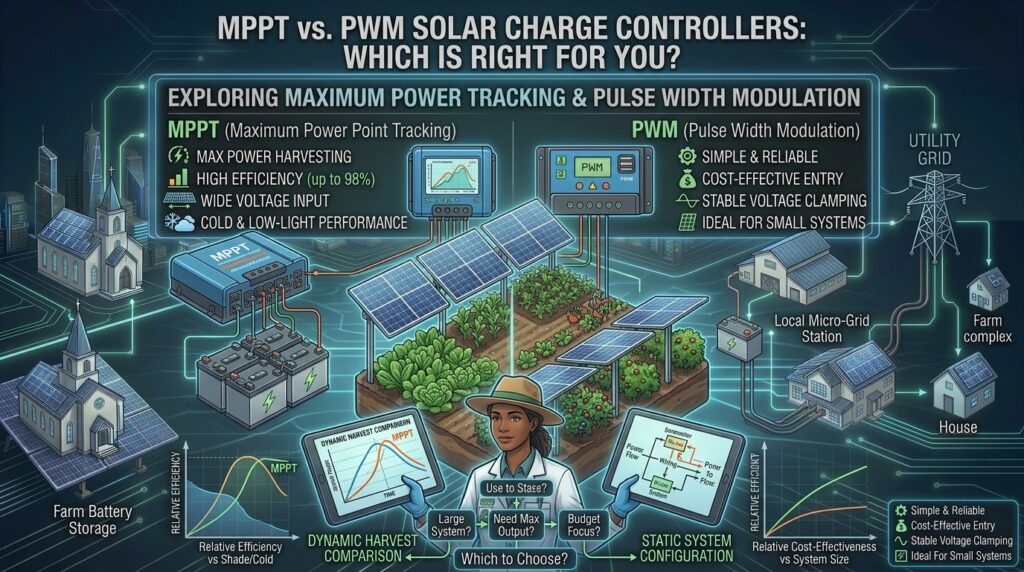
Pulse Width Modulation (PWM) controllers are the simpler of the two technologies. A PWM controller works like a rapidly switching connection between the solar panel and the battery. It adjusts the connection in pulses to regulate charging as the battery reaches its target voltage. :contentReference[oaicite:1]{index=1}
The main limitation is that PWM generally operates the solar panel closer to the battery voltage. If the panel could produce its maximum power at a higher voltage, that extra voltage is not converted into additional charging current.
For example, a solar module designed to operate above a battery’s charging voltage may not deliver its full available power when connected through PWM. This is why panel and battery voltage matching is especially important with PWM systems.
Advantages of PWM Controllers
- Lower upfront cost
- Simpler design and operation
- Reliable for small, straightforward solar systems
- Often easier to install and configure
Disadvantages of PWM Controllers
- Less flexible with different panel and battery voltages
- Usually not ideal for higher-voltage solar arrays
- May not capture as much available panel power when voltage mismatch exists
- Provides fewer options for future system expansion
How MPPT Solar Charge Controllers Work
Maximum Power Point Tracking (MPPT) controllers use more advanced electronics to find the operating point where the solar panels produce the most power. The controller then converts that power into the voltage and current needed by the battery bank. :contentReference[oaicite:2]{index=2}
Unlike PWM, MPPT can separate the solar array voltage from the battery voltage within the controller’s operating limits. This allows a solar array to operate at a higher voltage while still charging a lower-voltage battery system.
This flexibility can be useful when:
- Solar panels are installed farther from the batteries
- The array uses panels wired in series
- The system needs more energy collection during changing conditions
- The solar setup may expand later
Advantages of MPPT Controllers
- Better use of solar panel output when voltage differences exist
- Greater flexibility in solar array design
- Works well with higher-voltage panel configurations
- Can be beneficial in colder conditions because panel voltage changes with temperature
Disadvantages of MPPT Controllers
- Higher purchase cost
- More complex electronics
- Requires careful sizing of maximum input voltage and charging current
MPPT vs PWM: Key Differences
| Feature | MPPT Controller | PWM Controller |
|---|---|---|
| Technology | Tracks the solar panel’s maximum power point and converts voltage | Uses pulse-based regulation between panel and battery |
| Voltage flexibility | Handles a wider range of panel-to-battery voltage differences | Works best when panel and battery voltages are closely matched |
| System complexity | More advanced electronics | Simpler electronics |
| Typical application | Larger, expandable, or higher-voltage battery systems | Small and simple solar installations |
| Upfront cost | Usually higher | Usually lower |
How System Voltage Affects the Choice
Your battery bank voltage and solar array voltage are two of the biggest factors when selecting a charge controller.
A PWM controller generally requires closer matching between the solar panel voltage and the battery charging voltage. If the panel voltage is significantly higher than the battery voltage, much of that available voltage cannot be used effectively.
An MPPT controller can often take advantage of higher-voltage solar arrays because it converts the incoming power into a form the battery can use. However, the controller must still stay within its rated limits for:
- Maximum solar input voltage
- Maximum charging current
- Battery voltage compatibility
Temperature and Solar Array Considerations
Temperature affects solar panel performance. Solar panels typically produce higher voltage in colder conditions and lower voltage in hotter conditions. This matters because the controller must be able to handle the expected range of solar array voltage throughout the year.
MPPT controllers can provide additional flexibility in situations where temperature changes significantly affect panel operating conditions. PWM systems may perform well when the array is already closely matched to the battery system.
Array design also matters. Wiring panels in series increases array voltage, while wiring panels in parallel increases current. MPPT controllers are commonly used when a higher-voltage array design is beneficial, but every system must be checked against equipment specifications.
When Should You Choose PWM?
A PWM controller may be a reasonable choice when:
- You have a small solar system
- Your panel voltage closely matches your battery system
- You want a simple and affordable setup
- You do not need much future expansion
Examples might include smaller backup systems, basic off-grid applications, or simple battery charging setups where maximum energy harvesting is not the primary goal.
When Should You Choose MPPT?
An MPPT controller may make more sense when:
- Your solar array operates at a higher voltage than your battery bank
- You have a larger solar installation
- You want flexibility for adding more panels later
- Your panels are located farther from the batteries
- You want to maximize available solar production
For many modern battery-based solar designs, MPPT provides additional design flexibility. However, it is not automatically the correct answer for every small system.
How to Choose the Right Solar Charge Controller
| Question | Why It Matters |
|---|---|
| What is your battery voltage? | The controller must support the battery bank configuration. |
| What is your solar array voltage? | The controller must handle the panel input range. |
| How large is the solar array? | Larger systems often benefit from MPPT flexibility. |
| Will you expand the system later? | Future growth may influence controller selection. |
| What are your installation conditions? | Temperature, shading, and wiring distances affect performance. |
Frequently Asked Questions About MPPT vs PWM Controllers
Is MPPT always better than PWM?
No. MPPT controllers offer advantages in many situations, especially when solar array voltage differs significantly from battery voltage. However, PWM can be a practical and cost-effective choice for smaller systems with properly matched components.
Can I use an MPPT controller with a 12V battery?
Yes. MPPT controllers are commonly used with 12V battery systems. The important factors are the solar panel specifications, controller ratings, and correct system design.
Can PWM and MPPT controllers use the same solar panels?
Sometimes, but compatibility depends on the panel voltage, battery voltage, and controller limits. A panel configuration that works well with MPPT may not be ideal for PWM.
Does cold weather affect solar charge controller choice?
Yes. Cold temperatures can increase solar panel voltage, so the controller must be rated to handle the highest expected array voltage. MPPT systems may also take better advantage of changing operating conditions.
Do residential solar panels need a charge controller?
Not always. Traditional grid-connected home solar systems typically use inverters with built-in power management features. Separate charge controllers are mainly used when solar panels charge batteries directly.
Final Thoughts
The choice between MPPT and PWM is not about picking the newest technology—it is about matching the controller to your solar system. PWM controllers can work well for simple, properly matched installations, while MPPT controllers provide more flexibility for higher-voltage arrays, larger systems, and changing conditions.
Before choosing a controller, review your solar panel specifications, battery requirements, temperature conditions, and plans for future expansion. A properly matched system will provide reliable performance and help you get the most value from your solar investment.