Can You Grow Crops Under Solar Panels? Agrivoltaics Explained.
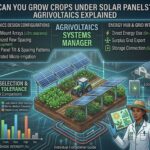
Solar panels and farming may seem like competing uses of land, but a growing approach called agrivoltaics shows that they can sometimes work together. Agrivoltaics combines solar energy production with agricultural activities, allowing crops, livestock, or pollinator habitats to exist underneath or between solar panels. :contentReference[oaicite:0]{index=0}
For homeowners, farmers, and property owners interested in solar, this raises an important question: can you actually grow crops under solar panels? The answer is yes in some situations, but success depends on the crop, climate, solar design, and how the land is managed. Agrivoltaics is not simply placing panels over a garden and expecting everything to grow the same way. It requires thoughtful planning to balance electricity production and agricultural needs.
What Is Agrivoltaics?
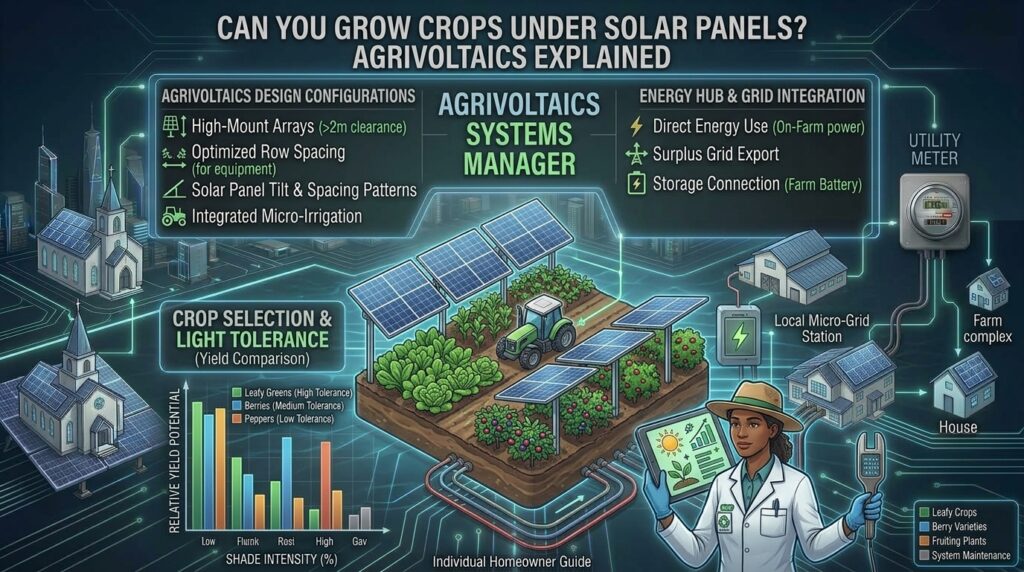
Agrivoltaics (also called dual-use solar or agrisolar) is the practice of using the same area of land for both solar photovoltaic (PV) energy generation and agricultural production. Instead of removing land from agricultural use, a properly designed solar installation can allow farming activities to continue alongside electricity generation. :contentReference[oaicite:1]{index=1}
There are several common approaches to agrivoltaics:
| Agrivoltaic Approach | How It Works | Possible Uses |
|---|---|---|
| Elevated solar panels | Panels are mounted higher above the ground to allow plants, equipment, or animals to use the space below. | Crops, grazing, research plots, pollinator habitats |
| Panel rows with agricultural space | Crops are planted between rows of solar panels where they receive more direct sunlight. | Vegetables, forage crops, specialty crops |
| Solar grazing | Livestock graze around and beneath solar arrays while vegetation management occurs naturally. | Sheep, some other grazing animals, pasture management |
How Can Plants Grow Under Solar Panels?
Plants need sunlight, so it may seem surprising that crops can grow beneath solar modules. However, many plants do not require full, direct sunlight all day. Partial shade can sometimes create a more favorable growing environment, especially in areas where heat and water stress are challenges.
Solar panels can change the microclimate around plants by affecting sunlight exposure, soil temperature, and moisture levels. Research and demonstration projects have explored how shading can benefit certain crops by reducing evaporation and protecting plants from extreme weather conditions. :contentReference[oaicite:2]{index=2}
However, the results are not the same for every crop. Some plants need high levels of direct sunlight and may perform poorly when shaded. Crop selection is one of the most important decisions in an agrivoltaic system.
Crops That May Work Well With Agrivoltaics
The best crops for solar integration are often those that can tolerate partial shade or benefit from reduced heat exposure. Examples that may be considered include certain vegetables, berries, herbs, forage plants, and specialty crops. :contentReference[oaicite:3]{index=3}
Crop choices should be based on local growing conditions, soil quality, available sunlight, irrigation needs, and the design of the solar array. A crop that performs well under panels in one region may not be suitable in another.
Can Livestock Be Raised Under Solar Panels?
Agrivoltaics is not limited to crops. Livestock integration, sometimes called solar grazing, is another common application. Animals can use the shaded areas beneath solar panels while helping manage vegetation around the system. :contentReference[oaicite:4]{index=4}
Solar arrays can provide shelter from intense sunlight, which may be valuable for grazing animals during hot weather. At the same time, grazing animals can reduce the need for mechanical vegetation maintenance when the site is designed appropriately.
| Livestock Consideration | Why It Matters |
|---|---|
| Animal size and behavior | The animals must be compatible with panel height, wiring, and equipment protection requirements. |
| Site access | Fencing, water access, and animal movement routes must be planned carefully. |
| Maintenance needs | Vegetation control and equipment inspections still require regular attention. |
Why Solar Panel Design Matters
Agrivoltaic systems require different design choices than a standard ground-mounted solar installation. The goal is to create enough space and access for agricultural activities while still allowing the solar panels to operate effectively.
Panel Height and Spacing
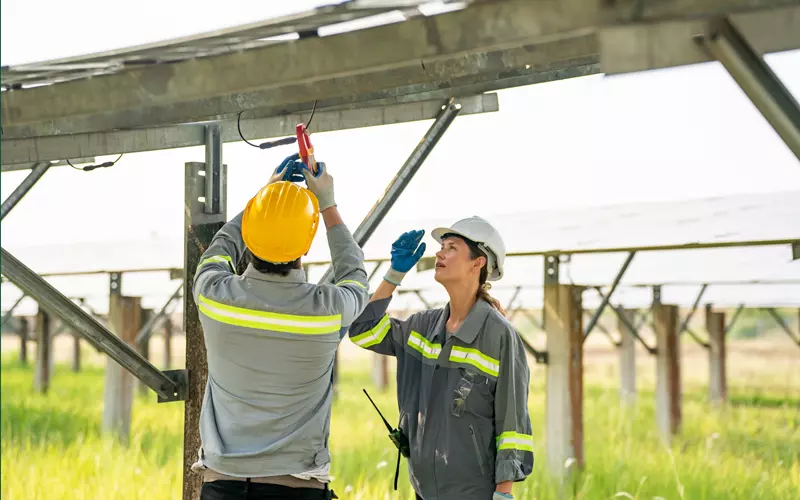
Panel height affects what can happen underneath the array. Higher mounting can make it easier for people, farm equipment, or animals to move through the area. Wider spacing between panel rows can allow more sunlight to reach crops and improve access for maintenance.
Panel Orientation and Layout
The direction panels face, their angle, and their spacing influence both electricity production and growing conditions. A design focused only on maximizing solar generation may not provide the conditions needed for certain crops. Agrivoltaic planning involves finding a balance between energy output and agricultural goals.
Effects on Water and Soil
Solar panels can influence how water moves across a site. Rainfall may be concentrated along panel edges, while shaded areas may experience slower evaporation. These changes can affect irrigation planning and soil moisture conditions.
In some environments, reduced evaporation can help conserve soil moisture. In other locations, careful planning may be needed to prevent uneven water distribution or drainage issues. Soil management practices, ground cover, and planting choices remain important parts of a successful system.
Benefits and Tradeoffs of Agrivoltaics
Agrivoltaics offers potential advantages, but it is not a universal solution. Every site involves tradeoffs between solar production, agricultural productivity, cost, and maintenance.
| Potential Benefits | Potential Challenges |
|---|---|
| Allows energy production and agriculture on the same land | Requires more detailed planning and design |
| May provide shade and reduce heat stress for some crops or animals | Some crops may not receive enough sunlight |
| Can support vegetation management and habitat goals | Maintenance and farming activities must work around solar equipment |
| Can diversify how land is used | Not every property or farming operation is suitable |
Where Does Agrivoltaics Make the Most Sense?
Agrivoltaics may be a good fit where land is valuable, energy needs are growing, and agricultural activities can be adapted to work with solar infrastructure. It is especially relevant for farms, rural properties, community solar projects, and locations where maintaining agricultural use is an important goal.
For residential property owners, the concept can also inspire smaller-scale ideas, such as combining solar with gardens, native plants, or pollinator-friendly landscaping. However, a typical rooftop solar system is usually designed for electricity production rather than agricultural use.
Frequently Asked Questions About Agrivoltaics
Can vegetables grow under solar panels?
Yes, some vegetables and specialty crops can grow under solar panels, especially when the system provides suitable levels of partial shade. The results depend on crop type, climate, and solar design.
Do solar panels prevent plants from getting enough sunlight?
Solar panels reduce the amount of direct sunlight reaching certain areas, so crop selection is important. Some plants benefit from partial shade, while others require more sunlight.
Can solar panels improve soil conditions?
Solar panels can influence soil temperature and moisture patterns, but they do not automatically improve soil. Good soil management practices are still necessary for successful agriculture.
Is agrivoltaics more expensive than regular solar?
Agrivoltaic projects may require additional design considerations, such as different mounting systems, spacing, and agricultural planning. Costs depend on the specific project goals and site conditions.
Can homeowners use agrivoltaics?
Most residential solar installations focus on producing electricity from rooftops or small ground-mounted systems. Larger properties may have opportunities to combine solar with gardens, landscaping, or agricultural activities depending on the layout and local requirements.
Final Thoughts: Combining Solar Energy and Agriculture
Agrivoltaics demonstrates that solar panels do not always have to compete with agriculture. With careful design, solar energy systems can sometimes support crop production, livestock management, and ecological goals at the same location.
The key is choosing the right combination of solar equipment, land use, crops, and management practices. For property owners exploring solar options, understanding concepts like agrivoltaics can help identify creative ways to make renewable energy work alongside existing land uses.
Rumos Chem provides residential solar information and installation guidance for homeowners interested in understanding how solar technology can fit their properties and energy goals.