How Do Net Metering Credits Roll Over From Month to Month?
For many homeowners considering solar, one of the biggest questions is what happens when their solar panels produce more electricity than their home uses. The answer often involves net metering credits, which allow excess solar energy sent back to the electric grid to be tracked and applied to future electricity costs.
Understanding how net metering credits roll over from month to month can help homeowners estimate savings, read their utility bills, and make informed decisions about solar energy. While the basic idea is similar across many programs, the details depend on the electric utility, state regulations, rate structure, and the specific net metering agreement.
Rumos Chem provides residential solar information and installation services for homeowners in St. Louis, Missouri. Because utility rules can change, homeowners should always confirm current net metering requirements with their electric utility and applicable regulators before making decisions about a solar system.
What Are Net Metering Credits?
Net metering is a billing arrangement that tracks the difference between the electricity your solar panels produce and the electricity your home consumes from the grid.
During sunny periods, a solar system may generate more electricity than the home needs. The extra energy can flow back to the electric grid, and the utility may provide a credit based on the rules of the applicable net metering program.
Later, when your solar panels produce less energy than your home requires, such as at night, during cloudy weather, or in higher-use seasons, those accumulated credits may help offset electricity charges.
| Situation | What Happens |
|---|---|
| Solar production exceeds home usage | Excess electricity may create a credit that is tracked on your utility account. |
| Home uses more electricity than solar produces | Available credits may be applied according to the utility’s net metering rules. |
| Credits remain after the monthly bill is calculated | Credits may carry forward to a future billing period if the program allows it. |
How Do Solar Credits Roll Over Each Month?
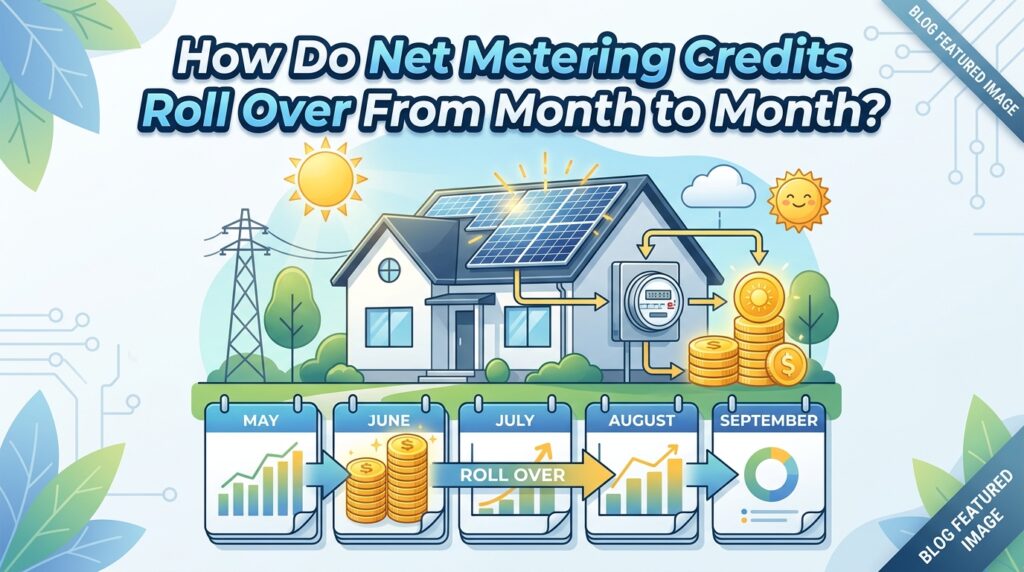
In many net metering programs, unused solar credits do not disappear at the end of every month. Instead, they continue into the next billing cycle.
For example, a homeowner may generate extra electricity in April when solar production increases. If that credit is not fully used during April, the remaining balance may move into May. If May is another high-production month, the credit may continue growing. Later, during months with lower solar production, those credits may help reduce electricity charges.
The rollover process generally follows this pattern:
| Billing Period | Example Credit Activity |
|---|---|
| Month 1 | Solar produces more electricity than the home uses, creating a credit balance. |
| Month 2 | Credit carries forward and may offset electricity charges. |
| Month 3 | Lower solar production may allow previously earned credits to be used. |
The exact way credits are calculated can vary. Some utilities track credits in kilowatt-hours (kWh), while others track monetary credits based on approved rates. Time-of-use pricing, seasonal rates, and other billing structures may also affect how credits are valued. :contentReference[oaicite:0]{index=0}
What Is an Annual True-Up?
Many net metering programs include an annual review period called a true-up. Instead of resetting credits every month, the utility reviews the account over a longer period, often around 12 months, and reconciles the total charges and credits.
At the annual true-up, several things may happen:
- The homeowner may have a remaining balance owed if electricity usage exceeded available credits.
- The homeowner may have remaining excess credits, depending on the utility program rules.
- Unused credits may be handled according to the utility tariff, which could include expiration, compensation, or another method.
For example, some utilities describe monthly credits and charges as carrying forward through a 12-month billing cycle before being reconciled through an annual true-up statement. :contentReference[oaicite:1]{index=1} However, the outcome for unused credits varies significantly between utilities and locations.
Do Net Metering Credits Expire?
There is no single nationwide rule for net metering credit expiration. Whether credits expire, are carried forward indefinitely, or receive some type of compensation depends on the program rules established by the utility and regulators.
Some programs may reset unused credits after an annual true-up. Others may allow credits to continue rolling over or provide a different form of credit for excess generation. :contentReference[oaicite:2]{index=2}
Because these rules can change, homeowners should review the current tariff, interconnection agreement, and utility documentation that applies to their property.
How Utility Rules Affect Credit Carryover
Net metering is not identical everywhere. Two homeowners with similar solar systems may experience different credit treatment if they are served by different utilities or live under different state regulations.
Important differences may include:
- Credit value: Some programs credit excess energy at a rate tied to retail electricity charges, while others use different compensation methods.
- Rollover period: Some programs allow monthly carryover until a yearly settlement period.
- True-up timing: The reconciliation date may depend on when the system was interconnected or the utility’s billing schedule.
- Credit expiration: Some programs may limit how long unused credits remain available.
What Should St. Louis Homeowners Know About Net Metering?
Homeowners in St. Louis should start by identifying their electric utility and reviewing the current solar interconnection and net metering policies that apply to their address.
Missouri solar rules and utility programs can change over time. Before installing solar, homeowners should confirm:
- Whether net metering is available through their utility.
- How excess solar generation is credited.
- Whether credits roll over monthly.
- When the annual true-up occurs.
- What happens to unused credits at the end of the true-up period.
Questions to Ask Your Utility Before Installing Solar
Getting answers before installation can prevent surprises later. Consider asking:
- How are excess solar credits calculated?
- Are credits tracked in kilowatt-hours or dollars?
- Do credits carry over from month to month?
- Is there an annual true-up date?
- Can unused credits expire?
- Are there minimum monthly charges that credits cannot offset?
- Are there changes planned for the current net metering program?
Frequently Asked Questions About Net Metering Credit Rollover
Do solar credits automatically disappear every month?
No. Many net metering programs allow unused credits to carry into future billing periods. However, the exact rollover rules depend on the utility and program requirements.
Can I save solar credits for the winter?
In many programs, monthly rollover allows homeowners to accumulate credits during higher-production months and use them when solar production decreases. Whether this applies to a specific home depends on the utility’s rules.
What happens if I produce more solar electricity than I use all year?
The result depends on the applicable net metering program. Some utilities may provide compensation for excess generation, while others may reset remaining credits during the annual true-up process.
Does installing a battery change how net metering credits work?
A battery can change how and when electricity is used in a home, but it does not automatically change the utility’s net metering rules. Homeowners should review battery and solar policies with their utility and installer.
Where can I find the current net metering rules for my home?
The best sources are your electric utility, state regulatory agency, and official solar interconnection documents. Rules should be verified before making financial decisions because programs and requirements may change.
Understanding Solar Credits Helps You Plan Your Energy Future
Net metering credit rollover is designed to account for the natural mismatch between when solar panels produce electricity and when a home uses energy. Monthly carryover, annual true-ups, and credit expiration policies determine how much value homeowners receive from excess solar generation.
For St. Louis homeowners exploring solar, understanding these billing details is an important part of evaluating a solar investment. Rumos Chem helps homeowners learn how residential solar systems work and what questions to ask before installation. Always verify current net metering rules directly with your utility and regulators before moving forward.