How Does a Home Battery Save Money on Time-of-Use Rates?
For many homeowners, solar panels are the first step toward lowering electricity costs. However, the timing of when electricity is used can also affect monthly bills. Time-of-use (TOU) rates are designed around this idea by charging different electricity prices during different parts of the day. A home battery can help homeowners take advantage of these rate differences by storing energy when it is less expensive and using it when electricity costs more.
For St. Louis homeowners considering solar and energy storage, understanding how batteries work with time-of-use pricing can help determine whether a battery system fits their energy goals. Utility rate structures, household energy habits, solar production, and battery size all play a role in potential savings. Some Missouri utilities, including Ameren Missouri, offer residential rate options that encourage shifting electricity use away from higher-cost periods. :contentReference[oaicite:0]{index=0}
What Are Time-of-Use Electricity Rates?
Traditional electricity pricing usually charges a similar energy rate regardless of when electricity is consumed. Time-of-use rates work differently. They divide the day into periods when electricity demand is higher or lower, with different prices assigned to each period.
The goal is to encourage customers to use electricity during times when demand on the grid is lower. For example, some TOU plans may have lower-cost overnight hours and higher-cost afternoon or evening hours. Exact schedules and pricing depend on the utility and rate plan selected. :contentReference[oaicite:1]{index=1}
| Electricity Period | Typical Characteristics | How a Battery Can Help |
|---|---|---|
| Off-Peak Hours | Lower electricity demand and potentially lower rates | Battery can charge from the grid or store excess solar energy |
| Peak Hours | Higher demand and potentially higher electricity costs | Battery can provide stored energy instead of purchasing as much electricity |
| Solar Production Hours | Usually when rooftop panels generate electricity | Battery can store unused solar energy for later use |
How Does a Home Battery Lower Electricity Costs?
A battery does not create electricity. Instead, it changes when electricity is used. This is valuable because the price of electricity can vary throughout the day under a time-of-use plan.
1. Store Lower-Cost Electricity
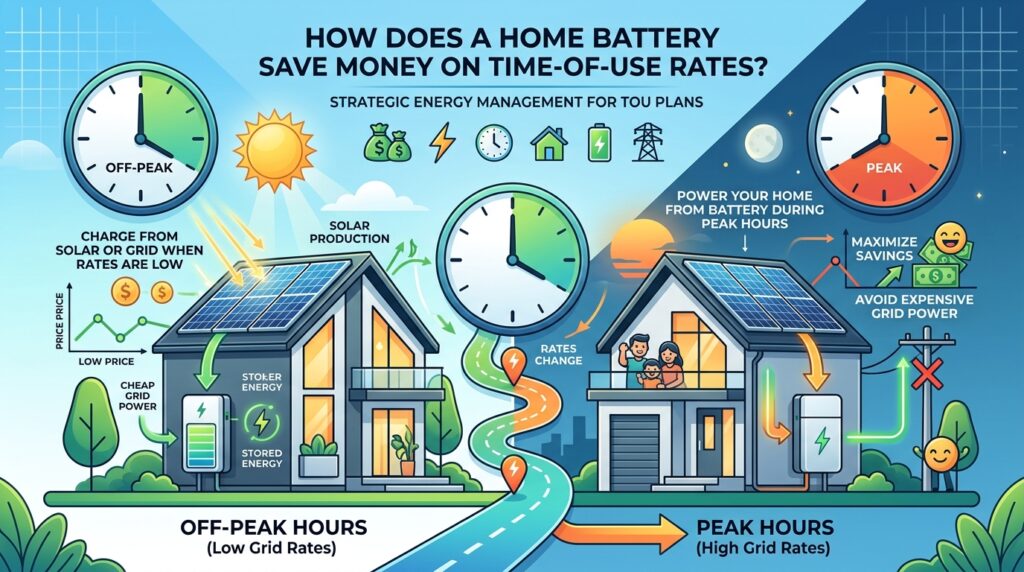
If a homeowner is on a TOU rate with cheaper overnight electricity, a battery can charge during those lower-cost hours. The stored energy can then be used later when rates increase.
This process is sometimes called energy arbitrage. The battery takes advantage of the difference between lower-cost and higher-cost electricity periods.
2. Use More Solar Energy at Night
Solar panels usually produce the most electricity during daylight hours, but many households use significant amounts of electricity in the evening. Cooking, lighting, entertainment systems, and air conditioning often continue after the sun goes down.
Without a battery, excess solar electricity may be sent back to the grid depending on the system setup and utility rules. With a battery, homeowners can store some of that solar energy and use it later in the day.
3. Reduce Electricity Purchases During Expensive Hours
The biggest potential benefit of battery storage under TOU rates comes from reducing electricity purchases during peak pricing periods. Instead of drawing all electricity from the grid during expensive hours, the home can use energy stored earlier.
For St. Louis homes, this can be especially relevant during periods of high cooling demand. Summer afternoons and evenings may be important times to manage electricity use because air conditioning can represent a large portion of household energy consumption.
How Solar and Battery Storage Work Together
A solar-plus-battery system can provide more flexibility than solar panels alone. During sunny periods, solar panels can power the home and charge the battery with extra production. Later, the battery can discharge to support household loads.
| System Setup | Energy Use Pattern | TOU Rate Benefit |
|---|---|---|
| Solar Only | Uses solar power while available; relies on the grid at other times | May reduce total electricity purchases but does not shift stored energy into peak periods |
| Battery Only | Stores grid electricity and supplies power later | Can shift usage from higher-cost periods to lower-cost periods |
| Solar Plus Battery | Stores excess solar and can also manage grid charging | Provides more options for controlling when electricity is used |
Does a Battery Always Save Money?
A home battery can reduce electricity costs in the right situation, but savings are not automatic. Several factors affect whether the investment makes financial sense:
- Your electricity rate structure: A larger difference between peak and off-peak prices creates more opportunity for savings.
- Your energy habits: Homes with high evening electricity use may benefit more from stored energy.
- Your solar production: A properly sized solar system may provide more energy to store.
- Battery size and efficiency: Batteries have limits on how much energy they can store and deliver.
- Installation costs and incentives: The total project cost affects the long-term financial picture.
Homeowners should evaluate battery storage based on their specific electricity usage, utility rules, and goals. A battery may also provide backup power benefits during outages, which is separate from TOU savings.
What Should St. Louis Homeowners Consider Before Installing a Battery?
Before adding battery storage, homeowners should review their current electricity bills and understand when they use the most energy. Many utilities provide usage information that can help identify daily patterns. Ameren Missouri, for example, provides residential rate options that include time-based pricing choices designed around shifting energy use. :contentReference[oaicite:2]{index=2}
Important questions to consider include:
- Does my utility offer a time-of-use rate?
- When does my home use the most electricity?
- Will the battery mainly provide bill savings, backup power, or both?
- How much solar energy can my panels produce throughout the year?
- Is the battery compatible with my solar equipment and electrical system?
>
How Rumos Chem Helps Homeowners Evaluate Solar Battery Options
Choosing a home battery is not only about selecting equipment. It requires understanding how the system interacts with your home’s electricity use, solar production, and utility rate structure.
Rumos Chem provides residential solar information and installation guidance for homeowners in the St. Louis, Missouri area. A professional evaluation can help determine whether battery storage is appropriate for your home and how it may fit with your energy goals.
Frequently Asked Questions About Home Batteries and Time-of-Use Rates
Can a home battery eliminate my electric bill?
A battery can reduce electricity purchases, but it does not usually eliminate all utility costs. Homes typically remain connected to the electric grid and may still have fixed charges or other fees depending on the utility and rate plan.
Do I need solar panels to use a home battery?
No. Some battery systems can charge from the electrical grid. However, pairing a battery with solar panels allows homeowners to store excess solar production for later use.
How does a battery know when to charge and discharge?
Many modern battery systems use software controls that can be programmed around electricity rates, solar production, and homeowner preferences. Settings can often be adjusted to prioritize savings, backup power, or other goals.
Are time-of-use rates available to every homeowner in St. Louis?
Availability depends on the electric utility, service area, and specific customer eligibility requirements. Homeowners should check current rate options with their utility before planning a battery system.
Is a home battery worth it for every solar homeowner?
Not necessarily. The value of battery storage depends on electricity rates, household usage patterns, system design, and personal priorities. A solar professional can help compare expected benefits with project costs.
Final Thoughts
Home batteries can help homeowners make better use of time-of-use electricity rates by shifting energy consumption away from expensive periods. For solar homeowners in St. Louis, battery storage may provide an additional way to manage energy costs while increasing control over how and when electricity is used.
The best battery solution depends on each home’s energy profile. Reviewing utility rates, solar production, and household electricity habits is the first step toward determining whether energy storage makes sense for your property.