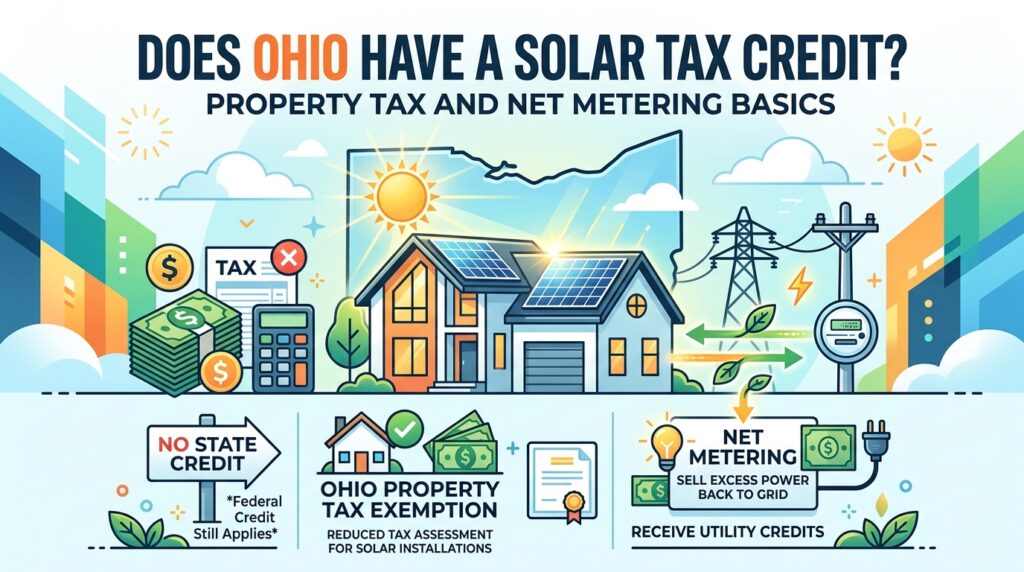
Does Ohio Have a Solar Tax Credit? Property Tax and Net Metering Basics
If you are researching solar in Ohio, one of the first questions you will probably ask is whether the state offers a solar tax credit. The short answer is that Ohio’s incentive picture is built more around property tax treatment and net metering than around a headline state income tax credit. This guide explains how those pieces generally work, what to ask before you sign anything, and where to confirm the current rules.
Important note: Rumos Chem is a residential solar information and installation site serving St. Louis, Missouri. We are not a distributor, and this article is general education, not tax, legal, or financial advice. Incentive rules change, and Ohio utilities and counties apply them differently. Always verify current details with official sources and qualified tax or energy professionals.
The Short Answer: Ohio Solar Tax Credits in Plain English
To the best of our knowledge, Ohio does not offer a broad statewide personal income tax credit specifically for installing residential solar. That does not mean Ohio homeowners have no incentives. Ohio’s solar economics are typically shaped by three layers:
- Federal tax provisions: These have changed significantly in recent years and may no longer be available for systems installed today.
- Ohio property tax treatment: State law generally addresses how solar equipment affects property tax, which matters for your long-term cost of ownership.
- Net metering: Rules set through Ohio utility regulation determine how you are credited for excess electricity your system sends to the grid.
Because programs can be added, modified, or ended, treat any blog post, including this one, as a starting point for your own research rather than a final answer.
Quick Comparison: The Main Incentive Categories
The table below summarizes the categories Ohio homeowners commonly ask about and where to confirm the current status of each.
| Incentive Category | What It Generally Covers | Where to Verify |
|---|---|---|
| Federal residential solar tax credit | Historically, a federal income tax credit for eligible residential solar expenses. Recent federal legislation changed the timeline, so eligibility depends on when expenses are incurred and how the system is owned. | IRS.gov and a qualified tax professional |
| Ohio state income tax credit | Ohio has generally not had a broad state income tax credit for residential solar. Confirm nothing new has been enacted. | Ohio Department of Taxation |
| Property tax treatment | Rules on whether the added value of solar equipment increases the taxable value of a home. | Your county auditor and the Ohio Department of Taxation |
| Sales tax treatment | Whether solar equipment or installation is taxed or exempt can depend on how the purchase is structured. | Ohio Department of Taxation and a tax professional |
| Net metering | How your utility credits excess electricity sent to the grid and how those credits are applied on your bill. | Your utility and the Public Utilities Commission of Ohio (PUCO) |
| Local or utility programs | Occasional rebates, financing programs, or pilot offerings that vary by location and time. | Your utility, municipality, and county |
The Federal Piece: Do Not Assume It Applies
For years, the federal residential clean energy credit was the centerpiece of solar incentives across the country. However, federal law changed, and the credit for homeowner-purchased systems was scheduled to end for expenses paid after the end of 2025. Whether any federal credit applies to a project depends on the date expenses are incurred, whether you purchase or lease the system, and other details of your tax situation.
Why Ownership Structure Matters
Buying a system with cash or a loan, leasing it, and signing a power purchase agreement (PPA) are treated differently for tax purposes. In some leasing and PPA arrangements, the company that owns the system, not you, may claim certain federal tax benefits, and how much of that is reflected in your monthly payment is a matter of contract terms. Ask any installer to explain in writing who owns the system and who claims which benefits.
Practical Tips on Federal Rules
- Do not accept a verbal claim that you “will get” a federal credit. Ask the installer to point to the specific IRS guidance they are relying on.
- Talk to a CPA or enrolled agent about your own tax liability before making decisions that depend on a credit.
- Keep contracts, invoices, and proof of payment dates organized in case they matter for your tax filing.
Ohio Property Tax and Solar: The Basics
Property tax is where many homeowners worry that solar could raise their bills. Adding equipment to your home could, in theory, increase its assessed value. Ohio law has generally addressed this concern by providing property tax treatment intended to keep solar equipment from increasing the taxable value of qualifying properties. The specifics, including what qualifies and any application steps, can be technical.
What to Confirm With Your County
Ohio property is assessed at the county level, so your county auditor’s office is the best place to ask how solar is handled locally. Useful questions include:
- Does a residential rooftop solar system affect the assessed value of my home?
- Is any application or paperwork required to claim an exemption?
- How does a ground-mounted system compare with a roof-mounted system?
- Does the answer change if the system is leased rather than owned?
Property Value Versus Property Tax
These are not the same thing. Solar may affect how a buyer perceives your home in the market even if it does not change the taxable value. Whether and how much a system helps resale value depends on the local market, the system’s condition, and the terms of any lease or loan attached to it. If you plan to sell, ask a local real estate professional how solar is viewed in your area.
Net Metering in Ohio: How Bill Credits Work
Net metering is the mechanism that lets your solar system export excess electricity to the grid and receive credit for it. In Ohio, net metering is governed by rules under the Public Utilities Commission of Ohio, and it generally applies to customers of the state’s regulated electric utilities. The details can differ for municipal utilities and electric cooperatives, which may follow their own policies.
The Basic Idea
Your solar panels produce electricity when the sun is out, often when you are using less power. Your home draws from the grid at other times, such as evenings. Net metering tracks both directions so that exports can offset imports on your bill. Whether the credit is valued at the full retail rate, a different rate, or in another form is exactly the kind of detail you should verify with your utility rather than assume.
Key Net Metering Terms to Know
| Term | What It Means | Question to Ask Your Utility |
|---|---|---|
| Net metering | A billing arrangement that credits exported solar energy against energy you draw from the grid. | Is net metering available to my account type and service territory? |
| Excess generation credit | The credit for electricity your system exports beyond what you use in a billing period. | How is the credit valued, and how long does it carry forward? |
| Interconnection | The process and agreement that allow your system to connect to the utility grid. | What is the application process, and what documents and inspections are required? |
| System size limits | Rules that may relate the size of your system to your electricity use. | Are there caps that could affect how I size my system? |
| Bill fees and minimum charges | Fixed charges that may remain on your bill even when solar offsets usage. | Which charges will I still pay after installing solar? |
| Permission to operate | Approval from the utility to turn on your system after installation. | Who submits paperwork, and how long does approval typically take? |
Why Net Metering Rules Affect Your System Design
Net metering policy influences how a system should be sized and how quickly a project pays for itself. A good installer or energy adviser should consider your actual usage history, roof orientation, shading, and future plans, such as an electric vehicle or heat pump, before recommending a system size. Be cautious about any proposal that promises specific savings without showing its assumptions.
Questions to Ask About Any Proposal
- What utility rate and net metering assumptions does this estimate use?
- What happens to the estimate if rates or policies change in the future?
- How was my annual electricity usage determined?
- Are equipment and workmanship warranties provided in writing?
- Who handles the interconnection application and permits?
Other Ohio Considerations Worth Checking
Beyond the big three topics of federal rules, property tax, and net metering, several other factors can affect your decision.
- Sales tax: Confirm with the Ohio Department of Taxation or a tax professional how solar purchases are treated in your situation.
- Local permits and codes: Cities, townships, and counties may have their own permitting, inspection, and setback requirements.
- HOA and deed restrictions: Some neighborhoods have rules about panel placement or appearance. Ohio law may address certain restrictions, so check both your governing documents and current law.
- Financing programs: Loans, local programs, and other financing options vary. Compare total costs, terms, and fees in writing.
- Insurance: Tell your homeowner’s insurer about the system and ask whether your policy needs updating.
A Practical Checklist Before You Go Solar
Use this checklist to organize your research. Each item points to a source you can consult directly.
| Step | Action | Who to Contact |
|---|---|---|
| 1 | Gather 12 months of electric bills to understand your usage. | Your utility account portal |
| 2 | Confirm current net metering and interconnection rules. | Your utility and PUCO |
| 3 | Ask how solar affects your property’s taxable value. | Your county auditor |
| 4 | Review whether any federal or other tax benefit applies to you. | A CPA or enrolled agent |
| 5 | Collect multiple written proposals and compare assumptions. | Licensed, insured local installers |
| 6 | Review HOA rules, permits, and insurance requirements. | HOA, local building department, insurer |
| 7 | Read contract terms on ownership, warranties, and transfer if you sell. | Installer, and an attorney if needed |
Red Flags When Reviewing Solar Incentive Claims
Incentive rules are complicated, which makes them easy to oversimplify. Watch for these warning signs:
- Claims that a tax credit is guaranteed regardless of your tax situation.
- Pressure to sign quickly because an incentive is “about to expire” without a citation to an official source.
- Savings estimates with no stated assumptions about rates, usage, or net metering.
- Vague answers about who owns the system and who receives tax benefits.
- Reluctance to put promises in writing.
Where to Verify Current Ohio Rules
Because incentives change, rely on primary sources whenever possible:
- Public Utilities Commission of Ohio (PUCO): Net metering and interconnection rules for regulated utilities.
- Your electric utility or co-op: Account-specific billing, tariff, and interconnection details.
- Ohio Department of Taxation: State tax guidance, including sales and income tax questions.
- Your county auditor: Local property tax assessment questions.
- IRS.gov: Current federal tax rules and forms.
- A qualified tax professional or energy adviser: Guidance based on your specific circumstances.
Frequently Asked Questions
Does Ohio have a state solar tax credit for homeowners?
Ohio has not generally been known for a broad statewide income tax credit for residential solar. Programs can change, so check with the Ohio Department of Taxation and a tax professional to confirm whether anything new is available.
Will solar increase my Ohio property taxes?
Ohio law has generally provided property tax treatment aimed at preventing solar equipment from raising taxable value, but the details depend on the type of system and local administration. Ask your county auditor how your specific installation would be treated.
How does net metering work in Ohio?
Net metering lets excess electricity your system sends to the grid be credited against your usage. The exact crediting method, carryover of credits, and applicable fees depend on your utility and current regulations, so confirm the details with your utility and PUCO guidance.
Is the federal solar tax credit still available?
Federal law changed the timeline for the residential clean energy credit, and eligibility now depends on factors such as when expenses were incurred and how the system is owned. Check IRS.gov and speak with a qualified tax professional rather than relying on an installer’s summary.
Can Rumos Chem install solar in Ohio?
Rumos Chem is a residential solar information and installation site serving St. Louis, Missouri. This article is intended as general education for readers comparing incentive structures. If you live in Ohio, look for locally licensed installers and confirm current state and utility rules directly.
Final Thoughts
So, does Ohio have a solar tax credit? Ohio’s incentive landscape leans more on property tax treatment and net metering than on a state income tax credit, and federal rules have shifted enough that you should not assume they apply. The best approach is to gather your usage data, confirm current rules with official sources, request written proposals with clear assumptions, and consult a qualified tax or energy professional before committing. Solar can be a sound long-term decision for many households, but the details of your utility, county, and tax situation matter. This article is for general information only and does not constitute tax, legal, or financial advice.