What Are Tandem Solar Cells and Why Do They Set Efficiency Records?
Solar technology has improved dramatically over the past several decades, but traditional single-junction solar cells face a fundamental efficiency limit. Tandem solar cells are one of the most promising ways researchers are working to move beyond those limits. By combining two different solar materials into one device, tandem cells can capture more of the sunlight spectrum and convert more incoming energy into electricity.
For homeowners in St. Louis, Missouri considering solar, tandem technology represents an exciting area of research. However, most residential solar installations today still rely on proven silicon-based panels. Understanding where tandem solar cells fit into the future of solar energy can help homeowners make informed decisions about current and emerging technologies.
What Is a Tandem Solar Cell?
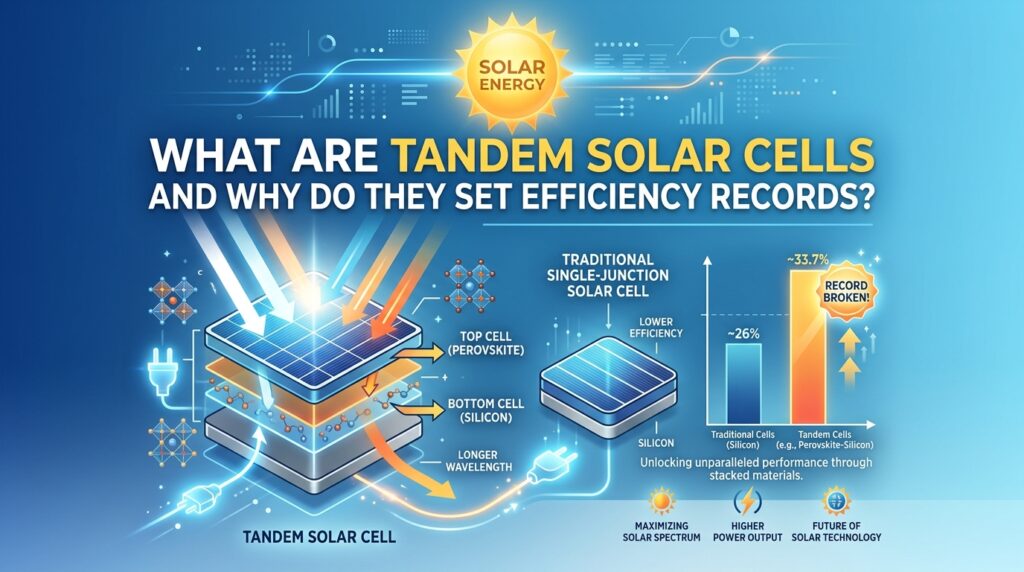
A tandem solar cell is a type of photovoltaic device that uses two layers of solar cell materials stacked together. Each layer is designed to absorb different portions of sunlight, allowing the cell to use more of the available solar energy.
Traditional solar panels typically use a single semiconductor material, most commonly crystalline silicon. Silicon is highly reliable and has been used in solar manufacturing for decades, but it cannot efficiently convert every wavelength of sunlight into electricity. Some sunlight passes through the cell or becomes heat instead of electrical energy.
Tandem cells address this limitation by adding another solar absorber on top of the silicon layer. The top layer captures higher-energy light, while the silicon layer underneath captures wavelengths that pass through the first layer.
| Solar Cell Type | How It Works | Main Advantage |
|---|---|---|
| Single-junction silicon | Uses one semiconductor material to convert sunlight | Reliable, widely manufactured, and proven for residential use |
| Tandem solar cell | Stacks two different solar materials with complementary absorption properties | Can capture more of the solar spectrum |
| Multi-junction solar cell | Uses multiple semiconductor layers | Very high efficiency potential for specialized applications |
Why Do Tandem Solar Cells Achieve Higher Efficiency?
The main reason tandem solar cells can achieve record efficiency is that they reduce one of the biggest limitations of traditional solar panels: wasted sunlight.
Every solar material has a property called a band gap. The band gap determines which wavelengths of light the material can effectively convert into electricity. A single material must compromise because it cannot be optimized for the entire solar spectrum.
A tandem cell uses different materials with different band gaps. For example, a perovskite top layer can be tuned to absorb higher-energy light, while a silicon layer underneath continues converting lower-energy light. This combination allows the device to produce more electricity from the same amount of sunlight.
Research organizations have reported that perovskite-silicon tandem cells have achieved laboratory efficiency levels above the traditional single-junction limit, demonstrating why this technology is attracting significant attention. The U.S. Department of Energy notes that perovskite materials can be adjusted to absorb different parts of the solar spectrum, making them useful partners for tandem designs. :contentReference[oaicite:0]{index=0}
Common Tandem Solar Cell Materials
Perovskite-Silicon Tandem Cells
Perovskite-silicon tandem cells are currently among the most studied tandem technologies. They combine a perovskite solar layer with a conventional silicon solar cell.
Perovskites are a family of materials with structures that allow researchers to adjust their optical properties. This flexibility makes them useful for creating a top layer that complements silicon rather than competing with it.
Laboratory demonstrations have shown impressive results. For example, independently certified perovskite-silicon tandem research cells have surpassed the efficiency ceiling associated with traditional single-junction designs. :contentReference[oaicite:1]{index=1}
Other Tandem Approaches
Researchers are also exploring combinations involving other materials, including different perovskite compositions and advanced semiconductor technologies. Some multi-junction approaches have been used in specialized applications such as space technology, where maximizing efficiency is especially important.
| Tandem Approach | Materials Used | Development Status |
|---|---|---|
| Perovskite-silicon | Perovskite layer combined with silicon solar cell | Active research and early commercialization efforts |
| Perovskite-perovskite | Two different perovskite absorber layers | Research stage with ongoing durability improvements |
| III-V multi-junction | Advanced semiconductor combinations | High-performance applications with higher costs |
Why Are Tandem Cells Setting Solar Efficiency Records?
Efficiency records are usually achieved in laboratory environments using carefully manufactured test cells. Tandem technology has gained attention because it offers a pathway beyond the practical limits of a single solar material.
The efficiency improvement comes from several engineering advantages:
- Better sunlight utilization: Different layers capture different portions of the solar spectrum.
- Higher voltage output: Combining materials can increase the electrical potential produced by the device.
- Reduced energy losses: Less sunlight is wasted as unused heat.
- Compatibility with existing silicon technology: Some tandem designs build on established silicon manufacturing.
Researchers have reported increasingly high efficiency results for perovskite-silicon tandem cells, including certified laboratory results above 30%. These achievements demonstrate the potential of tandem designs, although laboratory performance does not automatically mean the same performance is available in commercial rooftop panels. :contentReference[oaicite:2]{index=2}
Are Tandem Solar Panels Available for Homes?
Tandem solar technology is developing quickly, but most residential solar systems installed today use conventional silicon-based modules because they are widely available, durable, and supported by established manufacturing and installation processes.
For homeowners in St. Louis, Missouri, the most practical solar decision usually involves evaluating currently available equipment based on factors such as roof conditions, electricity usage, available incentives, and long-term energy goals.
Tandem panels may become more common in residential markets as manufacturers solve challenges related to manufacturing scale, durability, cost, and long-term performance testing.
Challenges Facing Tandem Solar Technology
Although tandem cells have impressive efficiency potential, several challenges remain before they become standard for residential installations.
- Manufacturing scale: Producing large quantities of tandem modules consistently is more complex than producing traditional silicon panels.
- Long-term durability: Some advanced materials require additional research to match the decades-long reliability expectations of conventional solar panels.
- Cost: New technologies must become economically competitive for widespread adoption.
- Field testing: Real-world conditions such as weather, temperature changes, and moisture exposure must be evaluated over time.
What Tandem Solar Cells Mean for the Future of Solar
Tandem solar cells represent an important step in photovoltaic research. Instead of replacing silicon completely, many tandem designs build on silicon’s strengths while adding another material to improve energy conversion.
For homeowners, this technology is worth watching because higher-efficiency panels could eventually allow more electricity production from limited roof space. However, current solar projects can already provide meaningful energy savings with commercially available panels.
Companies like Rumos Chem help homeowners understand solar options and make decisions based on available technology today while staying informed about future advancements.
Frequently Asked Questions About Tandem Solar Cells
What makes tandem solar cells different from regular solar panels?
Tandem solar cells use two solar materials stacked together instead of relying on one material. Each layer captures different parts of sunlight, which can increase overall efficiency.
Why do tandem cells have higher efficiency records?
Tandem cells can convert more of the solar spectrum into electricity because different layers are designed to capture different wavelengths of light.
Will tandem solar panels replace silicon panels soon?
Tandem technology is promising, but widespread residential adoption depends on continued improvements in manufacturing, durability, and cost. Traditional silicon panels remain the dominant choice for most home solar installations.
Are tandem solar cells better for every home?
Not necessarily. The best solar equipment depends on factors such as roof space, electricity consumption, budget, and project goals. Higher efficiency does not always mean the best overall choice for every property.
Can homeowners in Missouri install tandem solar panels today?
Availability depends on commercial product offerings from manufacturers. Most residential solar installations currently use established silicon panel technologies, while tandem products continue to develop.