What Size Solar Battery Does a Family of Four Need?
Choosing the right solar battery size is one of the most important decisions when planning a home solar energy system. For a family of four, the answer depends on much more than the number of people living in the home. Your household’s electricity use, backup power goals, solar panel production, appliance needs, and energy habits all affect the battery capacity that makes sense.
For homeowners in St. Louis, Missouri, a properly sized solar battery can help store excess solar energy produced during the day and make that energy available when the sun is not shining. It can also provide backup power during certain outages when paired with the right solar and electrical equipment. Energy storage systems are designed around how and when a home uses electricity, not simply household size. The U.S. Department of Energy explains that solar storage allows homeowners to save generated electricity for later use, including nighttime and outage situations.
There Is No Single Battery Size for Every Family of Four
A family of four may live in a small, energy-efficient home with modest electricity needs or a larger home with electric heating, multiple appliances, and higher daily consumption. Both households have four people, but their battery requirements can be very different.
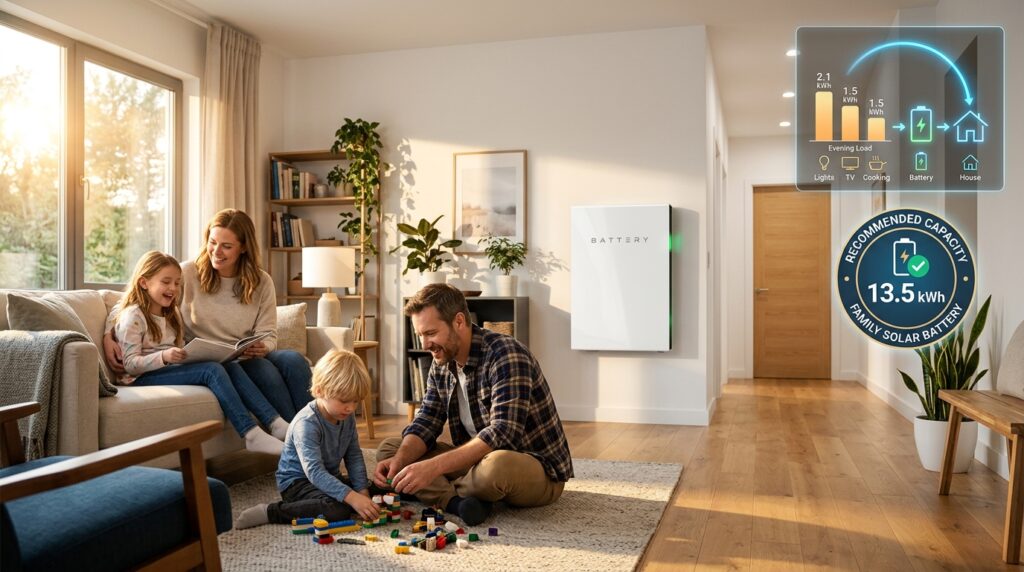
Solar batteries are typically measured in kilowatt-hours (kWh), which represents how much energy the battery can store. The correct size depends on questions such as:
- How much electricity does your home use each day?
- Do you want backup power only for essential appliances or for most of your home?
- Do you want to increase solar self-consumption?
- Do you have high-energy appliances such as electric heating, a heat pump, or an electric vehicle?
- How much solar energy can your panels produce?
A solar installer will usually review your electricity bills, home loads, and goals before recommending a battery size. General battery sizing guidance often focuses on usable energy capacity rather than household size alone. Battery sizing resources note that storage needs depend on energy usage, backup duration, and the usable capacity of the battery system.
Typical Solar Battery Size Considerations for a Four-Person Home
While every household is different, many residential solar battery systems are designed in the range of a single battery unit or multiple battery units depending on the homeowner’s goals. A smaller system may focus on keeping important circuits operating during an outage, while a larger system may store more energy for evening use or extended backup.
| Home Energy Goal | Battery Sizing Approach | Common Considerations |
|---|---|---|
| Basic outage backup | Size for critical loads | Prioritize essentials such as refrigeration, lighting, internet equipment, and selected outlets |
| More evening solar usage | Size around daily energy shifting needs | Store daytime solar production for use after sunset |
| Longer outage coverage | Increase usable storage capacity | Requires more battery capacity and careful load planning |
| Whole-home backup | Match battery capacity and power output to household demand | Large appliances and heating or cooling equipment may require additional planning |
How to Estimate Your Family’s Solar Battery Needs
1. Review Your Electricity Usage
The best starting point is your utility bill. Look at your monthly electricity consumption and calculate your average daily usage. This provides a baseline for understanding how much energy your home uses.
However, a battery is not always designed to replace all daily electricity use. Many homeowners install batteries to store extra solar energy, reduce reliance on grid electricity during certain times, or provide backup power for selected household circuits.
2. Decide What You Want the Battery to Do
The right battery size depends heavily on your goal.
Backup power: If your main concern is keeping important systems running during an outage, the battery can be sized around essential loads. This may include items such as refrigerators, lighting, communication devices, and selected electrical outlets.
Energy storage: If your goal is to use more of your solar electricity after sunset, the system may be sized around how much excess solar energy your panels typically produce during the day.
Maximum independence: Homeowners seeking longer periods of reduced grid dependence generally need more storage capacity, more solar production, and careful energy management.
3. Consider Your Major Appliances
Not all electrical devices use energy at the same rate. A refrigerator and LED lights require much less power than large heating, cooling, or cooking equipment.
| Home Feature | Why It Matters for Battery Sizing |
|---|---|
| Central air conditioning | Cooling equipment can require significant power, especially during hot weather |
| Electric heating | Heating demand can greatly affect winter electricity use |
| Electric vehicle charging | Charging can add substantial electricity consumption |
| Gas appliances | May reduce electricity demand compared with fully electric homes |
Why Battery Power Rating Matters Along With Battery Size
Many homeowners focus only on the battery’s kWh capacity, but another important specification is power output, measured in kilowatts (kW). Capacity determines how much energy is stored, while power determines how much electricity can be delivered at one time.
For example, a battery may have enough stored energy to run appliances for a period of time, but it must also have enough power output to handle the electrical demand of the devices operating simultaneously.
This is especially important for homes with larger appliances that may require more power when starting. A professional solar installer can evaluate both energy capacity and power requirements when designing a system.
Factors That Affect Solar Battery Sizing in St. Louis Homes
St. Louis homeowners should consider seasonal energy changes when planning solar storage. Missouri homes may experience significant differences between summer cooling needs and winter heating demands.
Other factors that can influence battery sizing include:
- Roof orientation and available sunlight for solar panels
- Household energy efficiency
- Utility rates and available programs
- Frequency and length of power outages
- Future plans such as adding an electric vehicle
Solar production can vary based on weather, season, shading, and system design. Storage works best when the battery, solar array, and household energy needs are considered together. The Department of Energy notes that storage helps shift solar energy from the time it is generated to the time it is needed.
Should a Family of Four Install One Battery or Multiple Batteries?
Some families may find that one battery provides enough storage for their goals, while others may benefit from additional capacity. Multiple batteries may be considered when homeowners have:
- Higher electricity consumption
- More backup circuits
- Longer outage coverage goals
- Large electrical appliances
- Plans for future energy use increases
Oversizing a battery system can increase costs and leave unused capacity, while undersizing may prevent the system from meeting expectations. The goal is to balance available storage with realistic household needs.
How Rumos Chem Helps Homeowners Evaluate Solar Storage Options
Rumos Chem provides residential solar information and installation services for homeowners who want to understand their solar and energy storage options. Every home has different electrical needs, so battery recommendations should be based on the property, energy usage, and homeowner goals.
A thoughtful solar battery evaluation can help homeowners understand how much storage they need, which circuits should receive backup power, and how solar generation can work together with battery storage.
Frequently Asked Questions About Solar Battery Size for a Family of Four
How many kWh battery does a family of four need?
There is no universal battery size based only on having four family members. The correct capacity depends on electricity consumption, backup goals, solar production, and appliance usage.
Can a solar battery power an entire house?
Yes, some solar battery systems can provide whole-home backup, but the required size depends on the home’s electrical loads and the battery system’s power output. Large appliances may require additional planning.
Is a bigger solar battery always better?
No. A larger battery is not automatically the best choice. The ideal system matches storage capacity with your actual energy needs and goals.
Can solar batteries work during a power outage?
Many solar-plus-storage systems can provide backup power during outages when properly designed and installed. The system must include appropriate equipment that allows safe operation during grid outages.
How do I know what battery size is right for my St. Louis home?
The best approach is to review your electricity usage, identify your backup priorities, and have a solar professional evaluate your home’s energy profile. This ensures the battery system is designed for your specific needs rather than a general household estimate.