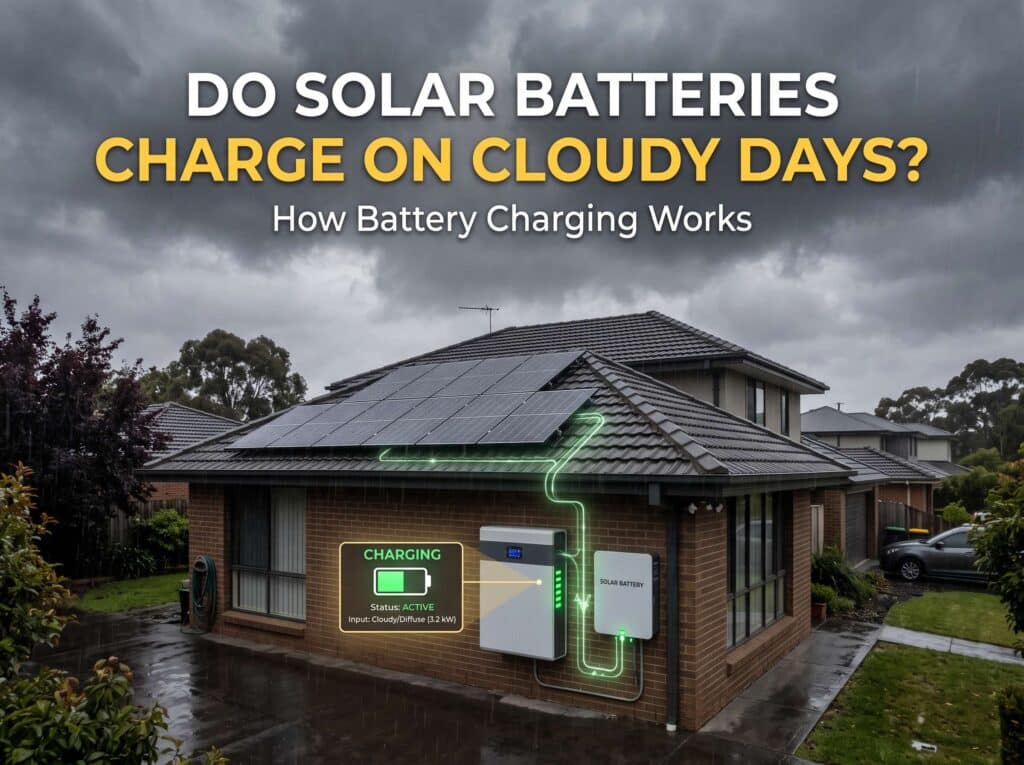
If you are considering adding a solar battery to your home, you may have wondered what happens when the sun is hidden behind clouds.
Do solar batteries charge on cloudy days?
Yes. Solar panels can still generate electricity when the weather is cloudy, which means they can also provide energy to charge a solar battery. However, solar panels generally produce less electricity on a cloudy day than they do under strong, direct sunlight.
How much electricity your system produces depends on the thickness of the cloud cover, the type and efficiency of your solar panels, the time of day, weather conditions, and other factors.
Understanding how solar batteries charge can help you set realistic expectations and determine whether battery storage is right for your home.
Can Solar Panels Produce Electricity on Cloudy Days?
Yes.
Solar panels do not require direct, unobstructed sunshine to produce electricity. They generate power from the light that reaches the solar cells.
Even when clouds cover the sun, some sunlight still passes through the clouds and reaches your solar panels.
The amount of electricity produced can vary significantly, however.
A bright, partly cloudy day may still provide good solar production, while heavy cloud cover can reduce output considerably.
This means your solar panels can continue generating electricity during cloudy weather, but they may not produce as much energy as they would on a clear day.
How Do Solar Batteries Charge?
A solar battery stores electricity generated by your solar panels.
During the day, your solar panels generate DC electricity. The system’s inverter converts electricity as needed for use in your home and battery storage.
A simplified process looks like this:
Solar panels → Inverter → Home + Battery
If your solar panels are generating more electricity than your home is currently using, the excess electricity can be directed toward the battery, depending on the system configuration.
For example:
Your solar panels generate 5 kW.
Your home is using 2 kW.
The remaining 3 kW may be available for battery charging, subject to system limitations and the battery’s charging capacity.
Once the battery is full, excess solar electricity may be exported to the grid if your system and utility allow it.
What Happens on a Cloudy Day?
On a cloudy day, your solar panels may continue generating electricity, but production may be lower.
Imagine that your solar system normally generates 30 kWh on a particular clear day.
If heavy cloud cover reduces solar production, the system might generate substantially less electricity that day.
The exact reduction cannot be predicted simply by saying “cloudy weather reduces production by X%.” Cloud thickness, cloud movement, temperature, panel orientation, location, and other conditions all matter.
If your home is using more electricity than the panels are producing, the battery may not charge at all.
Instead, the available solar electricity may go directly toward powering your home, while the remaining electricity comes from the battery or grid.
Do Solar Batteries Charge When It Is Overcast?
Yes.
Overcast weather does not automatically stop a solar battery from charging.
As long as your solar panels are generating sufficient electricity and the system is operating normally, some of that electricity can be used to charge the battery.
However, the battery may charge more slowly than it would on a sunny day.
For example, if your solar panels are producing only 1 kW because of heavy cloud cover and your home is consuming 1 kW at the same time, there may be little or no excess electricity available to charge the battery.
If solar production increases to 3 kW while your home continues using 1 kW, approximately 2 kW may be available for battery charging, depending on the system.
Can Solar Panels Charge Batteries in Rain?
Yes, solar panels can still produce electricity during rainy weather.
Rain itself does not prevent solar panels from generating power. The main issue is the reduction in sunlight caused by thick clouds.
Rainy conditions are often associated with heavy cloud cover, which can significantly reduce solar production.
However, some electricity generation can still occur.
Interestingly, rain can also help clean dust and dirt from the surface of solar panels, although rainfall should not be considered a substitute for proper solar panel maintenance in every environment.
How Much Do Solar Panels Produce on a Cloudy Day?
There is no universal percentage.
Solar production during cloudy weather can vary widely depending on the conditions.
Factors include:
- Cloud thickness
- Cloud coverage
- Time of day
- Season
- Solar panel technology
- Panel orientation
- Panel angle
- Shading
- Temperature
- Location
A lightly cloudy day may result in only a moderate reduction in production.
Heavy overcast conditions can cause a much larger decrease.
This is why solar system designers use local solar data and production modeling rather than assuming a fixed amount of energy will be generated every day.
Why Solar Panels Still Work Without Direct Sunlight
Solar panels use photovoltaic cells to convert light into electricity.
They do not only respond to the visible disk of the sun.
Light scattered through the atmosphere and clouds can still reach the solar cells.
As long as enough light reaches the panels, they can continue producing electricity.
However, less available sunlight generally means less electricity production.
This is similar to how you can still see outside on a cloudy day even though the sun is not directly visible.
There is still light reaching the ground.
What Happens If Your Solar Panels Produce Less Than Your Home Needs?
This is where battery storage can become particularly useful.
Suppose your home is using 2 kW.
Your solar panels are producing only 1 kW because of heavy clouds.
There is a 1 kW shortfall.
Depending on the system’s configuration and operating conditions, that remaining electricity could come from:
- A solar battery
- The electrical grid
- Another backup power source
If the battery has stored energy, it can potentially supply part or all of the shortfall.
This allows your home to continue using electricity even when current solar production is insufficient.
What If the Battery Is Already Full?
If your battery is fully charged, the system does not need to keep sending electricity into it.
Your home can use the available solar electricity first.
If solar production exceeds your home’s consumption, the excess may be exported to the electrical grid if permitted by your utility and system configuration.
The exact behavior depends on how your solar and battery system is configured.
What If the Battery Is Empty?
If your battery is depleted and your solar panels are not generating enough electricity to meet your home’s needs, your home may need to draw electricity from the grid.
For example:
Solar production: 1 kW
Home consumption: 2 kW
Battery: Empty
The remaining 1 kW may need to come from the grid.
If the electrical grid is unavailable during an outage, the situation is different.
In that case, your solar-plus-storage system needs sufficient solar production or stored energy to continue supplying the loads that are connected to the backup system.
Can Solar Panels Recharge a Battery During a Power Outage?
A properly designed solar-plus-storage system can potentially recharge its battery using solar panels during a grid outage.
However, not every grid-connected solar system automatically operates this way.
A standard grid-tied solar system is generally designed to shut down during an outage to protect utility workers and the electrical grid.
A battery backup system requires appropriate equipment and controls that allow the home to safely disconnect from the grid and operate independently.
When properly configured, solar panels can continue generating electricity during daylight hours and recharge the battery.
How Does Cloudy Weather Affect Backup Power?
Cloudy weather becomes more important during a prolonged power outage.
Imagine your battery is fully charged when the grid goes down.
Your home begins using stored energy.
The next day is sunny, and your solar panels produce enough electricity to power your essential loads and recharge the battery.
Your battery may then be ready for another night.
Now imagine the next day is heavily overcast.
Solar production may be much lower.
Your panels might still generate electricity, but not enough to fully recharge the battery while simultaneously powering your home.
If the outage continues, you may need to reduce electricity consumption to preserve battery capacity.
Can a Solar Battery Last Through Several Cloudy Days?
Potentially, but it depends heavily on the battery size, household consumption, and amount of solar production available.
A battery does not create electricity. It stores electricity generated previously.
If several days of poor weather occur, the battery may gradually become depleted if your home uses more energy than the solar panels produce.
For example:
Day 1: Battery starts at 100% → Cloudy → Battery ends at 70%
Day 2: Cloudy → Battery ends at 40%
Day 3: Heavy clouds → Battery ends at 15%
If solar production remains low and the outage continues, the available stored energy could eventually run out.
This is why battery capacity, solar array size, and household energy consumption should be considered together.
How Can You Make a Solar Battery Last Longer During Cloudy Weather?
When solar production is low, managing your electricity consumption can make a significant difference.
Reduce Unnecessary Electricity Use
Turn off lights, electronics, and appliances that are not needed.
Prioritize Essential Loads
During an outage, focus battery power on important equipment such as:
- Refrigerator
- Freezer
- Wi-Fi
- Security systems
- Essential lighting
- Medical equipment, where applicable
Limit High-Energy Appliances
Avoid unnecessary use of:
- Electric ovens
- Clothes dryers
- Space heaters
- Large air conditioners
- Electric water heaters
- EV chargers
These appliances can consume substantial amounts of stored energy.
Monitor Your Battery
Your battery monitoring system can show the state of charge and, depending on the equipment, current energy production and consumption.
Monitoring this information can help you decide when to reduce electricity usage.
Do Solar Batteries Charge at Night?
Generally, solar panels do not produce meaningful amounts of electricity at night, so they cannot normally charge a battery from solar energy after sunset.
However, some battery systems can potentially charge from the electrical grid depending on their configuration, utility rules, and the homeowner’s energy strategy.
For example, a battery might be programmed to charge from the grid during certain periods and use that stored energy later.
Whether this is beneficial depends on local electricity rates and the specific battery system.
Do Solar Batteries Need Direct Sunlight to Charge?
The battery itself does not need sunlight.
The solar panels need light to generate electricity.
The battery then stores the electricity produced by the solar system.
So the process is:
Sunlight → Solar panels → Electricity → Battery
If clouds reduce the amount of electricity produced by the solar panels, there may be less electricity available to charge the battery.
Does Temperature Affect Solar Battery Charging?
Temperature can affect battery performance and charging behavior.
Most modern battery systems are designed to operate within specified temperature ranges and include battery management systems to help maintain safe operating conditions.
Extreme temperatures can affect performance and may cause a battery system to limit charging or discharging under certain circumstances.
This is one reason battery installation location and manufacturer specifications matter.
Your installer should follow the manufacturer’s requirements for ventilation, temperature, clearances, and installation conditions.
Are Some Solar Panels Better for Cloudy Weather?
Solar panel performance can vary depending on the technology and design.
However, there is no panel that can completely eliminate the effects of cloudy weather.
Modern panels can still generate electricity from diffuse light, but heavy cloud cover reduces the amount of available solar energy.
When comparing panels, it is better to look at their complete specifications and expected performance rather than choosing a product simply because it is advertised as “better in cloudy weather.”
A professional system design should account for local weather and solar conditions.
Does Solar Panel Efficiency Matter on Cloudy Days?
Panel efficiency can matter, but it is not the only factor.
A higher-efficiency panel can produce more electricity from a given amount of available sunlight under appropriate conditions.
This can be particularly useful when roof space is limited.
However, the overall energy production of a solar system also depends on:
- Number of panels
- Panel orientation
- Panel angle
- Shading
- Temperature
- Weather
- Inverter performance
- System design
The best panel is therefore not necessarily the one with the highest efficiency rating alone.
What Happens When Clouds Suddenly Clear?
Solar production can increase quickly when cloud cover moves away and direct sunlight reaches the panels.
Your solar system responds to the available sunlight and adjusts its electricity production accordingly.
If your home is consuming less electricity than the panels are producing, the excess electricity can potentially be used to charge the battery.
If the battery is already full, the excess may be exported to the grid if your system and utility allow it.
Can Snow Prevent Solar Batteries From Charging?
Snow can affect solar production if it covers the panels and prevents sunlight from reaching the photovoltaic cells.
Light snow may sometimes slide or melt away, particularly on appropriately angled panels.
If panels are heavily covered, production can be significantly reduced until the snow clears.
The impact on battery charging therefore depends largely on how much solar electricity the panels can generate.
Why Battery Size Matters During Bad Weather
A larger battery gives you more stored energy to work with when solar production is low.
For example, a 5 kWh battery has less stored energy than a 10 kWh battery.
If both homes consume the same amount of electricity during a cloudy period, the larger battery can generally operate for longer before reaching its minimum state of charge.
However, a larger battery is not automatically the best solution.
Your battery should be sized based on:
- Your electricity consumption
- Backup goals
- Solar system size
- Typical outage duration
- Utility rates
- Budget
- Available installation space
Should You Get a Battery If You Live in a Cloudy Area?
Living in an area with frequent cloudy weather does not automatically mean solar battery storage is a bad investment.
Solar panels can still generate electricity under cloudy conditions, and a battery can store electricity produced during periods of higher solar production.
The financial and backup benefits depend on your specific circumstances.
A solar professional can evaluate your location’s solar resource, electricity consumption, roof conditions, utility rates, and outage history to determine whether battery storage makes sense.
Solar Batteries and Cloudy Days: What Homeowners Should Remember
The most important points are simple:
Solar panels can generate electricity on cloudy days.
They do not need bright, direct sunlight to produce power.
Cloudy weather generally reduces solar production.
The amount of reduction depends on the severity and type of cloud cover.
Solar batteries can still charge when solar panels are producing enough electricity.
However, charging may take longer when solar production is low.
Your home may use the available solar electricity before the battery charges.
If your home’s electricity consumption is greater than your solar production, there may be little or no excess electricity available for charging.
Several cloudy days can gradually deplete a battery.
If the battery is being used faster than the solar panels can recharge it, stored energy will eventually decrease.
Final Thoughts
So, do solar batteries charge on cloudy days?
Yes. Solar panels can continue producing electricity from the light available during cloudy weather, and that electricity can be used to charge a solar battery.
However, cloudy conditions generally mean less solar production. If your home is using more electricity than your panels are generating, there may not be enough excess energy to charge the battery quickly—or at all.
During a normal grid-connected day, the grid can provide the additional electricity your home needs. During a power outage, however, your battery and solar production become much more important.
A properly sized solar-plus-storage system can help you manage periods of low solar production, but battery capacity, solar array size, and household energy consumption all need to work together.
If you are considering solar battery storage, a professional assessment can help determine the appropriate battery size and solar system for your home, including how the system is expected to perform during cloudy weather and extended power outages.