Note: This article presents an illustrative example designed to demonstrate system design principles, load estimation, and sizing considerations for dual-EV households. It does not represent a real customer or historical company installation data.
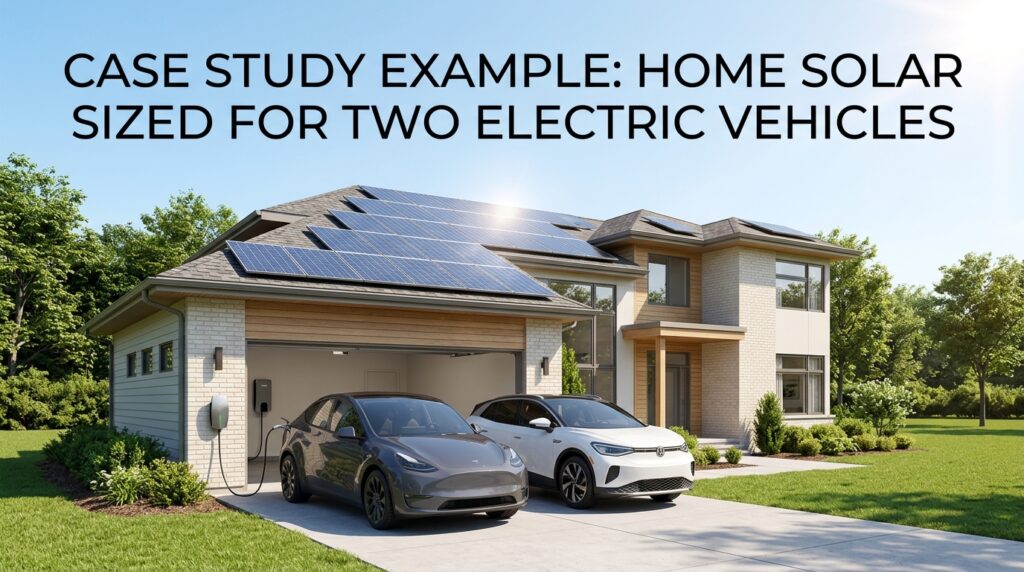
As electric vehicle (EV) adoption accelerates across the St. Louis metropolitan area, homeowners are increasingly realizing that adding two battery-electric vehicles to a household fundamentally changes their annual energy profile. Charging two EVs can easily double or triple a home’s baseline kilowatt-hour (kWh) consumption. In this guide, we break down an illustrative scenario showing how residential solar energy systems can be sized to meet the significant electrical demands of a two-EV household in St. Louis, Missouri, balancing energy independence, utility rate structures, and practical installation constraints.
1. The Household Scenario and Baseline Assumptions
To understand how solar sizing works when transportation energy is shifted onto the home electrical grid, consider a representative suburban St. Louis home. The household consists of four residents living in a detached single-family residence with a standard 200-amp main electrical service panel and a south/west-oriented roof space.
Before introducing electric vehicles, the home’s baseline consumption covers standard residential appliances, LED lighting, electronic devices, and a central heat pump or air conditioning unit suited for hot, humid Missouri summers and cool winters.
2. Estimating Dual EV Charging Energy Demands
Evaluating electric vehicle charging loads requires analyzing driving habits rather than just battery capacity. A vehicle with an 80 kWh battery pack does not require 80 kWh from the grid every night unless it is driven to full depletion daily.
In our model, we apply standard energy consumption metrics for typical passenger EVs operating in Midwestern weather conditions:
-
Commuter EV: Driven approximately 12,000 to 15,000 miles per year. Requiring roughly 33 kWh per 100 miles driven, this vehicle consumes roughly 4,000 to 5,000 kWh annually.
-
Family/Secondary EV: Driven approximately 6,000 to 8,000 miles per year. Consuming a similar efficiency rate, this vehicle requires roughly 2,000 to 2,700 kWh annually.
-
Total Additional Transportation Load: Adding both vehicles increases the home’s annual electricity requirements by 6,000 to 7,700 kWh.
When planning a system with Rumos Chem, analyzing these specific driving routines ensures that solar array capacity accurately reflects actual miles driven rather than simple guesswork.
3. Sizing the Solar Array for St. Louis Sun Hours
St. Louis, Missouri receives an average of approximately 4.2 to 4.5 peak sun hours per day when calculated as an annual average. Solar production fluctuates seasonally: summer months bring longer sun hours and higher potential daily generation, while winter months bring lower sun angles, shorter days, and occasional snow cover.
To offset approximately 17,000 kWh annually (covering both the home and two EVs), we apply standard Midwestern production ratio estimates. In Missouri, an unshaded, south-facing solar array typically produces between 1,150 and 1,300 kWh per year for every 1 kW of installed DC solar capacity.
4. Battery Storage and Backup Considerations
While an grid-tied solar array without storage offsets daytime energy usage and exports excess generation, adding battery storage provides key operational benefits for dual-EV households:
-
Time-of-Use (TOU) Optimization: If local utilities offer time-varying rates, stored daytime solar energy can power the home or charge vehicles during high-cost peak evening hours.
-
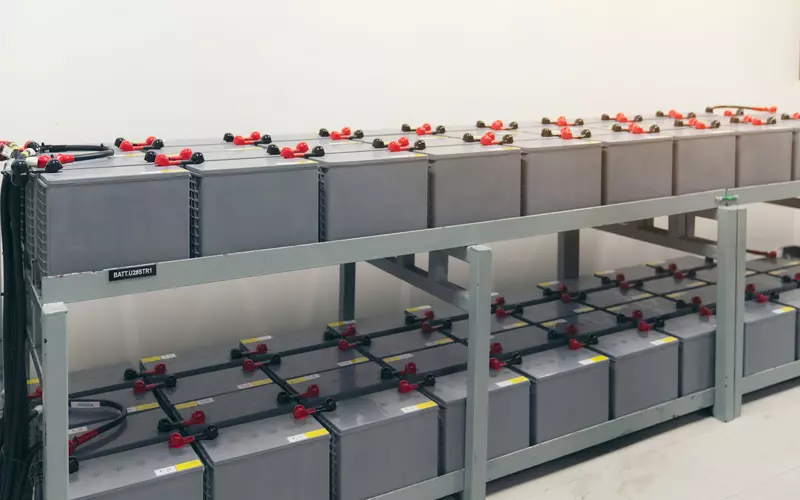
Resiliency During Grid Outages: Battery systems provide emergency backup power for critical home circuits like refrigeration, lighting, internet, and medical devices.
-
EV Charging During Power Outages: While charging two EVs simultaneously during an outage can rapidly deplete standard residential batteries (typically 10 to 15 kWh capacity per unit), smart energy management allows controlled, lower-amp Level 1 or selective Level 2 emergency charging into one vehicle if necessary.
5. Key Tradeoffs in High-Demand Solar Sizing
Designing a high-capacity solar installation requires balancing physical constraints against energy goals:
-
Roof Space vs. Target Offset: Fitting 32 to 36 panels requires uninterrupted, unshaded roof space. If roof geometry or shading reduces usable area, homeowners may opt for higher-efficiency modules, ground-mounted options, or a partial offset strategy.
-
Level 2 Charging Equipment & Electrical Panel Upgrades: Operating two 40-amp or 48-amp Level 2 EV chargers simultaneously demands significant electrical capacity. In many older St. Louis homes, upgrading to a 200-amp main service panel—or installing smart EV chargers that share a single circuit or throttle power based on live panel capacity—is necessary.
-
Capital Cost vs. Long-Term Fuel Savings: Sizing for two EVs increases initial solar equipment investment, but replacing gasoline expenses with solar-generated electricity significantly accelerates long-term total cost offsets.
6. St. Louis and Missouri Specific Considerations
Installing residential solar in St. Louis involves navigating local climate conditions and utility framework requirements:
-
Seasonal Climate Swings: St. Louis experiences significant seasonal temperature differences. Cold winter weather lowers EV battery efficiency, increasing kWh consumption per mile during winter months just as daily solar generation reaches its annual low.
-
Net Metering Guidelines: Missouri’s Net Metering and Solar Electric Systems Act requires investor-owned utilities to offer net metering for systems up to 100 kW. Understanding local utility interconnect agreements (such as those with Ameren Missouri) is crucial for managing seasonal energy credits.
-
Permitting and Historic Districts: Local municipal building codes across St. Louis County and St. Louis City, along with specific architectural guidelines in historic neighborhoods, govern structural roof loading, electrical conduit placement, and setback requirements. Working alongside Rumos Chem ensures system designs comply with local engineering and building standards.
7. Practical Tips for Dual-EV Solar Planning
If you are planning to transition to a dual-EV household powered by solar energy, consider the following actionable strategies:
-
Stagger Vehicle Charging Schedules: Set vehicle charging timers to run sequentially overnight (e.g., Vehicle A charges from 10:00 PM to 2:00 AM; Vehicle B charges from 2:00 AM to 6:00 AM) to minimize peak amperage loads on your main panel.
-
Use Smart EV Chargers: Select networked Level 2 chargers capable of load-balancing or dynamically adjusting charge rates based on real-time solar production.
-
Plan Solar Sizing Before or During EV Purchase: Gather at least 3 to 6 months of driving data or estimated mileage to accurately size your solar array prior to final equipment procurement.
-
Optimize Household Efficiency: Upgrading baseline home efficiency (such as sealing air leaks or tuning HVAC systems) frees up roof-generated kilowatt-hours to fuel your vehicles.
8. Frequently Asked Questions (FAQ)
Can a home solar system fully charge two electric vehicles?
Yes, provided the solar array is sized with sufficient wattage to cover both the home’s baseline usage and the combined annual driving mileage of both vehicles, and assuming adequate unshaded roof or ground space is available.
How many solar panels are generally needed for two EVs in St. Louis?
For average driving distances (15,000 miles on a primary car and 7,500 miles on a secondary car), charging requirements add roughly 6,000 to 7,700 kWh annually. In St. Louis, this additional demand alone typically requires about 12 to 16 modern high-efficiency panels, on top of the panels required for household electrical loads.
Do I need a battery storage system to charge my EVs with solar power?
No. Standard grid-tied solar systems allow you to export excess solar power to the grid during the day and draw grid power to charge your vehicles at night under local net metering programs. However, battery storage adds outage backup and energy management flexibility.
Will my main electrical panel need an upgrade for two EV chargers and solar?
Many homes with older 100-amp or 125-amp panels require an upgrade to a 200-amp main service panel to accommodate two 240-volt Level 2 EV charging circuits alongside a large solar photovoltaic interconnection. Smart load-sharing chargers can sometimes mitigate panel upgrade requirements.
How does cold winter weather in Missouri impact this design?
Cold temperatures temporarily reduce EV battery efficiency, requiring more kWh per mile driven. Solar array designs account for these seasonal shifts by using annual production and consumption averages rather than single-month estimates.