How Many Years Does a Home Solar Battery Last Before Replacement?
Adding a battery to a home solar system can provide backup power, increase energy independence, and help homeowners use more of their own solar electricity. However, unlike solar panels, which often continue producing power for decades, batteries have a limited service life and eventually lose storage capacity.
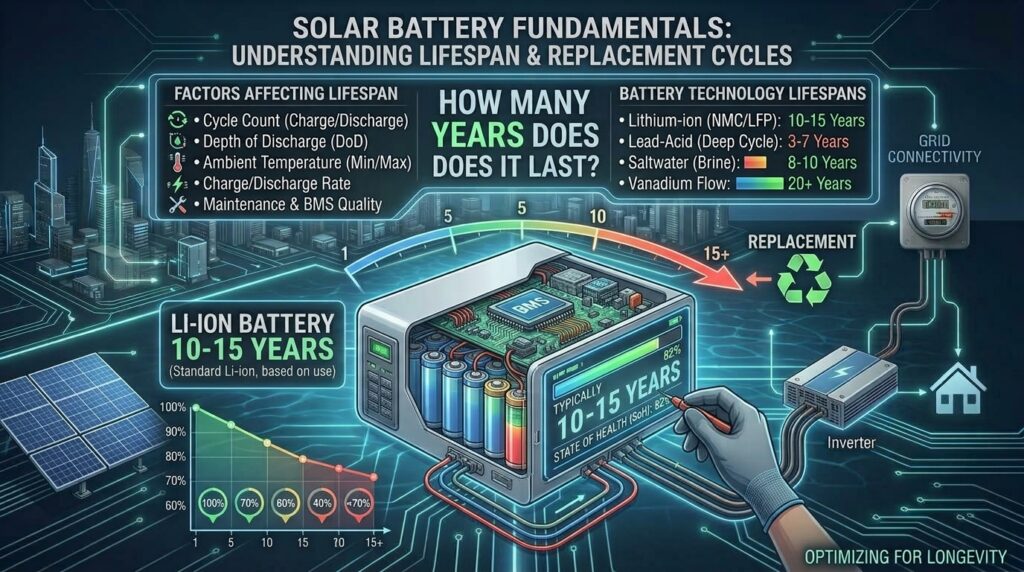
So, how many years does a home solar battery last before replacement? The answer depends on several factors, including battery chemistry, how often it is charged and discharged, operating temperature, installation conditions, and the manufacturer’s warranty terms. Many modern residential lithium-ion batteries are designed for long-term use, but homeowners should think about battery replacement as part of the overall solar ownership plan rather than expecting one universal lifespan number. :contentReference[oaicite:0]{index=0}
For homeowners in St. Louis, Missouri, understanding battery aging is especially useful because seasonal temperature changes can affect how storage systems perform over time. Choosing the right battery, installing it correctly, and monitoring its performance can help maximize its useful life.
Understanding the Expected Lifespan of a Home Solar Battery
A home solar battery does not usually fail suddenly after a specific number of years. Instead, it gradually loses its ability to store and deliver energy. This process is called degradation.
Modern residential solar batteries commonly use lithium-ion technology, including lithium iron phosphate (LFP) designs. Many systems are built with warranties covering a set period of years along with performance guarantees related to capacity retention, cycles, or total energy throughput. :contentReference[oaicite:1]{index=1}
| Battery lifespan factor | What it means for homeowners |
|---|---|
| Calendar aging | The battery naturally loses some capacity simply as it gets older, even with limited use. |
| Cycle aging | Charging and discharging the battery repeatedly causes gradual wear. |
| Temperature exposure | High heat can accelerate chemical changes inside battery cells and reduce longevity. |
| Depth of discharge | Frequently using a large portion of the battery’s capacity can increase wear. |
Battery Degradation: What Happens Over Time?
Battery degradation means the battery slowly stores less energy than it did when it was new. A system that originally stored a certain amount of electricity may provide less usable energy years later.
This does not necessarily mean the battery has stopped working. A battery with reduced capacity may still be useful for solar self-consumption or backup power. Replacement becomes a question of whether the remaining capacity still meets the homeowner’s needs.
Capacity Retention and End-of-Life Ratings
Solar battery warranties often include a minimum capacity retention guarantee. For example, a manufacturer may guarantee that the battery will retain a specified percentage of its original usable capacity after the warranty period, assuming the system is operated within approved conditions. :contentReference[oaicite:2]{index=2}
This is important because a warranty end date is not the same as a battery expiration date. A battery reaching the end of its warranty may still function, but it may no longer provide the same amount of stored energy as it did when new.
How Battery Cycling Affects Lifespan
A battery cycle occurs when stored energy is used and then replenished. Homeowners who use their battery every day for solar shifting may accumulate cycles faster than homeowners who mainly use their battery during occasional outages.
Battery warranties often consider both time and usage. Some warranties include a maximum number of cycles or a total energy throughput limit, meaning the warranty may end when either the time limit or usage limit is reached first. :contentReference[oaicite:3]{index=3}
| Usage pattern | Potential impact on battery wear |
|---|---|
| Occasional outage backup | Fewer cycles, which may reduce cycle-related wear. |
| Daily solar energy shifting | More regular cycling and greater use of the battery’s rated capacity. |
| Frequent deep discharges | May place more stress on battery cells compared with moderate usage patterns. |
The Role of Temperature in Solar Battery Life
Temperature is one of the most important environmental factors affecting battery performance. Lithium-ion batteries generally perform best when installed within the operating temperature range specified by the manufacturer.
High temperatures can speed up chemical reactions inside battery cells, which may increase degradation over time. In contrast, cold temperatures can temporarily reduce battery performance, especially charging ability, although the effect depends on the battery design and operating conditions.
For Missouri homeowners, where summers can bring heat and humidity while winters can bring freezing conditions, installation location matters. A battery installed in a protected area with appropriate temperature control may experience less stress than one exposed to extreme conditions.
Do Solar Batteries Require Maintenance?
Most modern home batteries are designed to operate automatically with built-in battery management systems. Homeowners typically do not perform regular maintenance like they would with older battery technologies.
However, good installation practices and occasional system checks can support long-term performance. Homeowners should:
- Keep the battery area clean and free from obstructions.
- Follow manufacturer recommendations for operating conditions.
- Monitor system alerts through the solar monitoring platform.
- Schedule professional inspections if unusual performance issues appear.
How to Evaluate a Solar Battery Before Buying
Instead of choosing a battery based only on the advertised warranty length, homeowners should review the complete warranty document and compare several factors.
Important Battery Specifications to Compare
| Specification | Why it matters |
|---|---|
| Warranty period | Shows the length of manufacturer coverage under stated conditions. |
| Capacity retention guarantee | Explains how much storage capacity is guaranteed after years of use. |
| Cycle or throughput limits | Shows how much usage the warranty covers. |
| Operating temperature range | Helps determine whether the battery suits the planned installation location. |
| Monitoring features | Makes it easier to track performance and identify issues. |
Planning for Future Battery Replacement
Battery replacement should be considered when planning the long-term cost and benefits of a solar system. A homeowner may decide to replace a battery when:
- The available storage capacity no longer covers important backup loads.
- The battery no longer supports the homeowner’s energy goals.
- Repair costs are not practical compared with installing newer technology.
- The system reaches the end of its warranty and performance declines significantly.
When replacement time arrives, homeowners may have new battery technologies, improved efficiency options, or different energy needs compared with when the original system was installed.
Frequently Asked Questions About Home Solar Battery Lifespan
How many years does a home solar battery usually last?
There is no single replacement date that applies to every battery. Lifespan depends on the battery model, chemistry, usage, temperature conditions, and warranty terms. Many modern residential lithium battery systems are designed for long-term operation, but actual service life varies. :contentReference[oaicite:4]{index=4}
Does a solar battery stop working when the warranty ends?
No. A warranty end date means the manufacturer’s coverage period has ended. The battery may continue operating afterward, although its available capacity may be reduced.
What causes solar batteries to wear out faster?
Frequent cycling, high temperatures, unsuitable installation conditions, and heavy use can contribute to faster degradation. Following manufacturer guidelines can help protect battery performance.
Can a solar battery be replaced without replacing solar panels?
In many cases, battery replacement can be handled separately from the solar panels. However, compatibility with the inverter, energy management system, and existing equipment should be evaluated before installation.
Should homeowners in Missouri install a solar battery?
The value of a battery depends on individual goals, including backup power needs, electricity usage patterns, utility rates, and the desired level of energy independence. A professional evaluation can help determine whether storage fits a specific home.
Final Thoughts
A home solar battery is a long-term investment, but it is also a component that naturally ages. Rather than focusing on one guaranteed replacement year, homeowners should understand how degradation, cycling, temperature, and warranty conditions affect real-world performance.
By selecting an appropriate battery, installing it correctly, and monitoring its condition over time, homeowners can make better decisions about solar storage and future replacement planning.