What Size Wire and Connectors Do You Need for Solar Panels? MC4 Basics
Solar panel wiring is one of the most important parts of a photovoltaic (PV) system. Panels may generate clean energy on the roof, but that energy still needs to travel through conductors and connectors safely and efficiently before reaching the inverter. Choosing the correct PV wire size and using properly matched connectors helps reduce energy losses, prevent overheating, and support reliable system operation.
For homeowners in St. Louis, Missouri, solar wiring decisions are especially important because outdoor equipment must handle seasonal temperature changes, sunlight exposure, weather, and long-term operation. While many residential solar systems use similar wiring concepts, there is no single wire size that works for every installation. The correct choice depends on current, distance, temperature, system design, and electrical requirements.
Why Solar Wire Size Matters
Solar wire sizing is about balancing two major factors: safety and performance. A conductor that is too small can create excessive heat and may not safely carry the expected current. A conductor that is technically safe but too small for a long cable run can also create unnecessary voltage drop, reducing the amount of power delivered to the inverter.
PV conductors are typically selected by checking ampacity requirements first and then verifying that voltage drop stays within an acceptable range. Electrical codes and professional design practices account for the fact that solar circuits can operate continuously for many hours during daylight conditions. :contentReference[oaicite:0]{index=0}
What Factors Determine Solar Panel Wire Size?
The correct PV wire size depends on several details of the solar array design. A qualified installer evaluates the complete system rather than choosing a wire gauge based only on panel wattage.
1. Current (Ampacity)
Ampacity refers to the maximum amount of electrical current a conductor can safely carry under specific conditions. Solar wire sizing begins with the current produced by the PV modules, including factors such as short-circuit current and required safety adjustments.
The wire must also be rated for the actual installation environment. A cable installed in a hot location, bundled with other conductors, or placed in conduit may require adjustments because heat affects how much current the wire can safely carry. :contentReference[oaicite:1]{index=1}
2. Voltage Drop
Voltage drop occurs because every wire has some electrical resistance. As current travels through a conductor, some energy is lost as heat. Longer cable runs and smaller conductors generally create more voltage drop.
For solar systems, voltage drop is an important design consideration because a PV array may be located far from the inverter or electrical equipment. Increasing conductor size can reduce resistance and help maintain system performance. :contentReference[oaicite:2]{index=2}
3. Cable Length
A short connection between a panel and inverter may require a different conductor size than a long run from a detached garage, ground-mounted array, or remote equipment location. Longer distances often require larger wire even when the current is unchanged.
4. Insulation and Environmental Rating
Solar wiring is not the same as ordinary household electrical wire. PV wire is designed for outdoor conditions, including sunlight exposure, moisture, and temperature changes. Many PV conductors are rated for direct outdoor use and are built with insulation intended for long-term solar applications.
| Wire Feature | Why It Matters |
|---|---|
| UV-resistant insulation | Helps protect cable exposed to sunlight |
| Temperature rating | Ensures the conductor can operate safely in heat |
| Outdoor moisture resistance | Supports long-term exterior installation |
| Proper voltage rating | Matches the electrical characteristics of the PV system |
Common PV Wire Sizes Used in Residential Solar
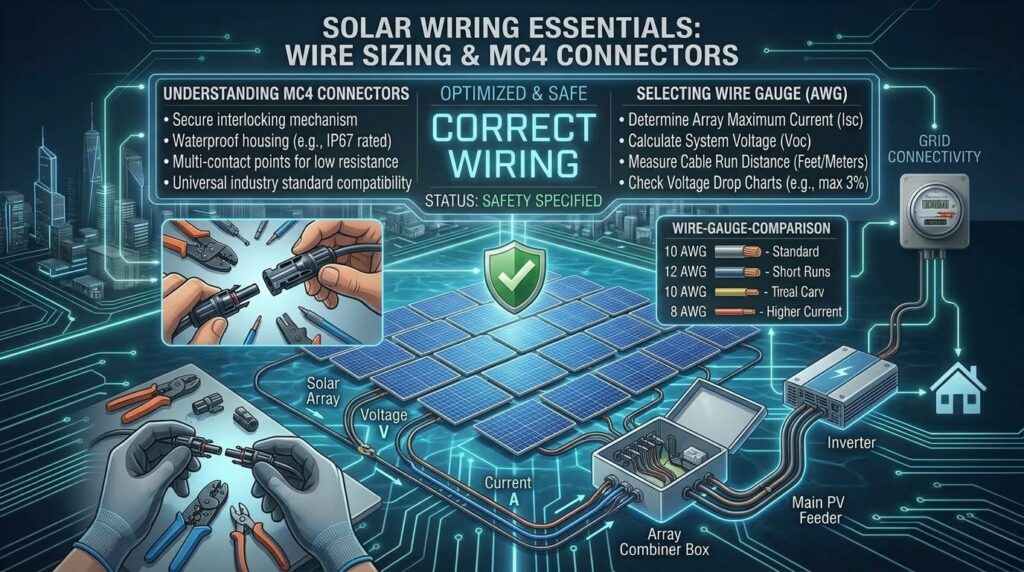
Residential solar installations commonly use copper PV wire in sizes such as 10 AWG, 12 AWG, and larger conductors for longer or higher-current runs. However, the correct size must be calculated for each project. A 10 AWG conductor may be appropriate for many residential string circuits, while longer distances or different array configurations may require a larger conductor. :contentReference[oaicite:3]{index=3}
| Wire Size Example | Common Considerations | When It May Be Used |
|---|---|---|
| 12 AWG PV Wire | Suitable only when current and distance requirements allow | Shorter runs or smaller PV circuits |
| 10 AWG PV Wire | Common residential choice, depending on design calculations | Many rooftop string installations |
| 8 AWG or larger | Used when current, distance, or voltage-drop requirements increase | Longer runs or combined circuits |
Understanding MC4 Solar Connectors
MC4 connectors are the locking DC connectors commonly found on modern solar modules. The name comes from the original Multi-Contact design and the 4 mm contact system. Most solar panels come with factory-installed connectors that allow panels to be connected into strings. :contentReference[oaicite:4]{index=4}
Although MC4 connectors look simple, proper installation matters. A connector is only reliable when the connector type, wire size, crimp connection, and sealing components are all compatible.
MC4 Connector Basics
- Positive and negative polarity: Solar connectors are keyed so the system wiring maintains correct polarity.
- Locking design: Properly mated connectors resist accidental separation.
- Weather protection: When correctly installed and fully connected, connectors are designed for outdoor PV environments.
- Correct crimping: The metal contact inside the connector must be properly attached to the conductor.
Why MC4 Compatibility Matters
The term “MC4-compatible” is often used broadly, but not all connectors that look similar are necessarily approved to be mixed together. Different manufacturers may have small differences in contact dimensions, locking mechanisms, or sealing designs.
Mixing incompatible connector brands can create poor electrical contact. Poor contact increases resistance, which can produce heat and create reliability problems over time. Using connectors that are properly matched and following manufacturer requirements helps maintain a safer PV system. :contentReference[oaicite:5]{index=5}
Solar Wiring Safety Considerations
Solar arrays produce DC electricity whenever sunlight is available. Even when the system is disconnected from the home electrical system, PV modules can still generate voltage. This makes proper installation practices essential.
- Always verify positive and negative polarity before connecting equipment.
- Use PV-rated wire instead of unsuitable indoor-only cable.
- Use the correct connector tools and crimping methods.
- Follow inverter, module, connector, and code requirements.
- Do not assume a connector is safe simply because it physically fits.
Why Qualified Solar Installation Matters
Solar wiring involves more than connecting panels together. A complete installation requires electrical calculations, equipment compatibility checks, proper protection devices, grounding, and compliance with applicable electrical requirements.
A qualified solar professional can evaluate factors such as roof layout, inverter location, cable routing, environmental conditions, and local requirements in the St. Louis area. Proper design helps ensure that the solar system operates safely and efficiently for many years.
Frequently Asked Questions About Solar Wire and MC4 Connectors
What size wire is normally used for solar panels?
There is no universal solar wire size. Many residential systems use 10 AWG PV wire, but the correct size depends on current, cable length, installation conditions, and voltage-drop requirements.
Can I use regular electrical wire for solar panels?
Standard indoor electrical wire is generally not designed for direct solar exposure. PV systems typically require conductors with insulation ratings appropriate for outdoor solar applications.
Are all MC4 connectors interchangeable?
No. Connectors that appear similar may not be designed for reliable interconnection. The safest approach is to use connectors approved by the equipment manufacturer and avoid mixing incompatible connector types.
Does thicker solar wire produce more electricity?
A larger conductor does not create more solar energy, but it can reduce electrical losses caused by resistance. Proper sizing helps more of the generated energy reach the inverter.
Can homeowners install MC4 connectors themselves?
Some homeowners work with small solar projects, but professional PV installations require careful electrical work. Incorrect crimps, damaged seals, reversed polarity, or incompatible connectors can create safety and performance issues.
Final Thoughts
Choosing the right solar wire and MC4 connectors is an important part of designing a dependable PV system. Wire size should be based on engineering factors such as current, voltage drop, distance, and environmental conditions—not a single rule that applies to every home.
For homeowners considering solar in St. Louis, understanding PV wiring basics can help you ask better questions and make informed decisions. A properly designed system uses the right conductors, compatible connectors, and professional installation practices to deliver safe and reliable solar energy.