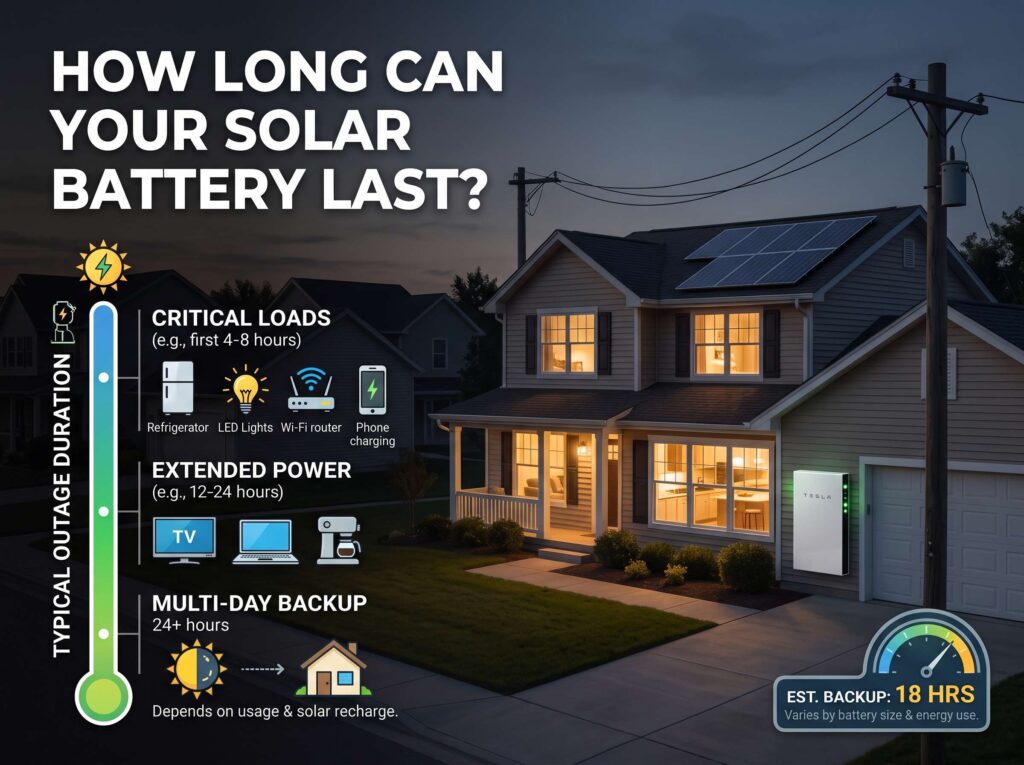
A power outage can happen at any time, especially during severe weather, equipment failures, or problems with the local electrical grid. If you have solar panels, you might assume that your home will continue running when the grid goes down.
But solar panels alone do not necessarily provide backup power during an outage.
A solar battery can store electricity and provide power to your home when the grid is unavailable. The important question is: how long can a solar battery power a house during an outage?
The answer depends on the battery’s capacity, your home’s electricity consumption, which appliances you want to operate, and whether your solar panels can recharge the battery during the outage.
A battery may power essential appliances for several hours, while a larger battery system combined with solar panels may provide backup power for a day or longer under the right conditions.
Let’s look at what determines backup runtime and how you can estimate how long a solar battery could power your home.
How Does a Solar Battery Provide Backup Power?
A solar battery stores electricity so it can be used later.
When the electrical grid is operating normally, your solar panels can generate electricity for your home. Depending on the system, excess solar energy can be stored in the battery.
When the grid goes down, a properly configured solar-plus-storage system can disconnect from the utility grid and provide electricity to designated home circuits or the entire home, depending on the system design.
A simplified process looks like this:
Solar panels → Battery → Home
During a sunny outage:
Solar panels → Home + Battery
At night or when solar production is insufficient:
Battery → Home
This allows stored solar energy to continue powering appliances after the grid goes offline.
How Long Will a Solar Battery Last During an Outage?
There is no single answer because every home uses electricity differently.
For example, a battery may last much longer when powering only essential appliances than when powering an entire home with air conditioning, electric heating, an electric water heater, and other high-power equipment.
The most important factors are:
- Battery capacity
- Household electricity consumption
- Appliance power requirements
- Battery usable capacity
- Inverter efficiency
- Battery reserve settings
- Solar panel production
- Weather conditions
- Whether the system powers the whole house or selected circuits
A small battery powering a few essential appliances could potentially last many hours.
A larger battery supporting a carefully managed household may provide power for a full day or longer.
What Is Battery Capacity?
Solar battery capacity is commonly measured in kilowatt-hours (kWh).
Think of kWh as the amount of energy a battery can store.
For example:
- 5 kWh battery = approximately 5 kWh of stored energy
- 10 kWh battery = approximately 10 kWh
- 15 kWh battery = approximately 15 kWh
- 20 kWh battery = approximately 20 kWh
However, the full rated capacity is not always available for household use.
Battery systems can have usable capacity limits, reserve settings, and energy losses.
This means a battery advertised with a particular capacity should not automatically be assumed to deliver that exact amount of electricity to your appliances.
How Do You Calculate How Long a Battery Will Last?
A simple way to estimate battery runtime is:
Battery runtime = usable battery capacity ÷ average household power consumption
For example, suppose you have a battery with 10 kWh of usable capacity and your home is consuming an average of 1 kW.
The simplified calculation would be:
10 kWh ÷ 1 kW = 10 hours
So the battery could theoretically provide around 10 hours of energy at that average load.
But this is only a basic estimate.
Real-world runtime can be shorter because of inverter losses, battery operating limits, temperature, reserve settings, and changes in household consumption.
Example: A 10 kWh Battery During an Outage
Let’s say you have a 10 kWh solar battery.
During an outage, you decide to power only essential appliances.
Your average load is approximately 500 watts, or 0.5 kW.
A simplified calculation would be:
10 kWh ÷ 0.5 kW = 20 hours
Under ideal conditions, that suggests approximately 20 hours of runtime.
But if your household starts using more electricity, the battery will drain faster.
For example, if your average load increases to 2 kW:
10 kWh ÷ 2 kW = 5 hours
The same battery could therefore provide very different runtimes depending on how much electricity your home uses.
What Can a Solar Battery Power During an Outage?
One of the best ways to extend battery runtime is to prioritize essential appliances.
Depending on the battery system and available power output, you may be able to operate appliances such as:
- Refrigerator
- Freezer
- Wi-Fi router
- Modem
- Lights
- Phones and device chargers
- Television
- Security cameras
- Small electronics
- Garage door opener
- Some medical or home equipment
Higher-power appliances can consume much more energy.
These may include:
- Central air conditioning
- Electric furnaces
- Electric water heaters
- Clothes dryers
- Electric ovens
- Large pool pumps
- EV chargers
- Space heaters
Running these appliances continuously can significantly reduce battery runtime.
How Much Electricity Does a Refrigerator Use?
A refrigerator is often considered an essential appliance during a power outage.
However, refrigerators do not usually consume their maximum rated power continuously. The compressor cycles on and off depending on temperature and operating conditions.
For this reason, actual energy consumption can vary considerably between models.
The same principle applies to many household appliances.
An appliance’s wattage rating tells you about its power demand, but energy consumption over time is what determines how quickly your battery will drain.
Can a Solar Battery Run an Air Conditioner?
Possibly, but air conditioning can be one of the biggest challenges for residential battery backup.
An air conditioner can require significant power when operating, and compressors can also have higher starting power requirements.
Whether your battery can operate your air conditioner depends on:
- Air conditioner size
- Starting power
- Running power
- Battery inverter capacity
- Other loads running simultaneously
- Battery state of charge
- System configuration
A system designed only for essential loads may not be capable of running a large central air conditioner.
If whole-home air conditioning during an outage is important to you, your solar installer should account for it when designing the battery and inverter system.
Can a Solar Battery Run an Entire House?
Yes, some battery systems can be designed to provide whole-home backup.
However, whole-home backup does not necessarily mean unlimited electricity.
The battery has a finite amount of stored energy.
If your home consumes electricity rapidly, even a large battery can eventually run out of energy.
For example, running lights, refrigeration, electronics, and a few essential circuits may allow a battery to last much longer than running HVAC equipment, water heating, cooking appliances, and other high-energy loads simultaneously.
Whole-home backup is therefore both a battery capacity question and an energy management question.
What Is the Difference Between Essential Loads and Whole-Home Backup?
There are generally two ways a battery backup system can be designed.
Essential Loads Backup
The battery powers selected circuits during an outage.
For example, you might choose:
- Refrigerator
- Kitchen lights
- Bedroom lights
- Wi-Fi
- Security system
- Selected outlets
This approach can reduce the amount of electricity your home consumes during an outage and extend battery runtime.
Whole-Home Backup
A larger system can be designed to provide backup power to much more of the home.
This may include larger appliances and HVAC systems, depending on the battery and inverter specifications.
Whole-home backup generally requires more battery capacity and appropriate electrical equipment.
Can Solar Panels Recharge the Battery During an Outage?
Yes, a properly designed solar-plus-storage system can often use solar panels to recharge the battery during a grid outage.
This is one of the biggest advantages of combining solar panels with battery storage.
For example:
Morning: Battery provides power → Solar production begins.
Afternoon: Solar powers the home → Excess solar charges the battery.
Evening: Solar production decreases → Battery supplies the home.
Overnight: Battery continues supplying essential loads.
The next day, solar panels can recharge the battery if sufficient sunlight is available.
This can potentially extend backup power beyond the battery’s initial stored energy.
What Happens on a Cloudy Day?
Solar panels can still produce electricity when the sky is cloudy, but production generally decreases compared with strong direct sunlight.
During a prolonged outage, this can become important.
If your battery is already partially depleted and solar production is low because of cloudy weather, you may need to reduce electricity consumption to preserve the remaining battery energy.
This is why backup planning should consider both battery capacity and expected solar production.
How Many Batteries Do You Need for a Whole House?
The number of batteries required depends on your electricity consumption and backup goals.
For example, a homeowner who wants to power only essential appliances may need significantly less storage than someone who wants to run:
- Central HVAC
- Refrigerator
- Water heater
- Cooking appliances
- Lighting
- Internet equipment
- Entertainment systems
- EV charging
If one battery provides 10 kWh of usable storage, two similar batteries could provide approximately 20 kWh of usable storage, assuming the system is designed and configured accordingly.
More storage can provide longer runtime, but battery sizing should also consider the maximum power output required by your appliances.
Battery Capacity Isn’t the Only Important Specification
When comparing solar batteries, it is easy to focus only on kWh.
But another important specification is power output, generally measured in kilowatts (kW).
Battery capacity tells you how much energy the battery can store.
Power output tells you how much electricity the system can deliver at a given time.
For example, a battery could have plenty of stored energy but still be unable to operate a large appliance if its inverter cannot provide the required power.
This is particularly important for appliances with high startup requirements.
A proper backup system therefore needs enough:
- Energy capacity
- Continuous power output
- Surge or starting power
- Inverter capacity
How Long Will a 5 kWh Battery Power a House?
A 5 kWh battery is relatively small for whole-home backup.
If your essential loads average 500 watts:
5 kWh ÷ 0.5 kW = 10 hours
If the average load is 1 kW:
5 kWh ÷ 1 kW = 5 hours
These are simplified calculations and actual runtime can differ.
A 5 kWh battery may be more appropriate for selected essential loads than for continuously powering an entire high-consumption home.
How Long Will a 10 kWh Battery Power a House?
A 10 kWh battery provides approximately twice the energy storage of a 5 kWh battery under otherwise comparable conditions.
At an average load of 500 watts:
10 kWh ÷ 0.5 kW = 20 hours
At an average load of 1 kW:
10 kWh ÷ 1 kW = 10 hours
At an average load of 2 kW:
10 kWh ÷ 2 kW = 5 hours
Again, these numbers are simplified estimates.
Actual runtime will depend on the usable battery capacity, inverter efficiency, battery reserve, and the appliances being powered.
How Long Will a 20 kWh Battery Power a House?
A 20 kWh battery provides substantially more stored energy.
At an average household load of 1 kW:
20 kWh ÷ 1 kW = 20 hours
At an average load of 2 kW:
20 kWh ÷ 2 kW = 10 hours
At an average load of 4 kW:
20 kWh ÷ 4 kW = 5 hours
A 20 kWh system can therefore provide considerably more backup capacity, but a high-consumption household can still drain it quickly.
Why Your Battery May Not Last as Long as Expected
Several factors can cause real-world battery runtime to differ from a simple calculation.
High Electricity Consumption
The more electricity your home uses, the faster the battery drains.
HVAC Operation
Heating and cooling can consume substantial electricity.
Battery Reserve
Some systems maintain a reserve percentage that is not normally available for everyday use.
Inverter Losses
Energy is lost when electricity is converted between different forms.
Battery Temperature
Battery performance can be affected by operating conditions and temperature.
Battery Age
Battery capacity can gradually decline over its useful life.
Additional Loads
You may use more electricity during an outage than you normally expect, particularly if the outage occurs during extreme weather.
How to Make Your Solar Battery Last Longer During an Outage
If an outage lasts longer than expected, managing your electricity consumption can significantly extend battery runtime.
Consider reducing or turning off unnecessary loads.
Prioritize Essential Appliances
Keep important appliances such as refrigeration, lighting, communications equipment, and security systems running.
Limit HVAC Usage
If possible, reduce heating or cooling consumption during extended outages.
Avoid High-Power Appliances
Avoid unnecessary use of electric ovens, dryers, space heaters, and other high-energy appliances.
Monitor Your Battery
Use your battery monitoring system or app to track remaining capacity and electricity consumption.
Use Solar Production Wisely
When solar production is available, take advantage of it while allowing the battery to recharge when appropriate.
What Happens When the Solar Battery Runs Out?
If the electrical grid is still down and your battery reaches its minimum state of charge, the backup system may stop supplying electricity.
At that point, your home could remain without power until:
- The grid is restored
- Solar production recharges the battery sufficiently
- Another approved backup power source becomes available
This is why battery sizing and energy management are especially important in areas where outages can last for many hours or days.
How to Size a Solar Battery for Your Home
The right battery size depends on what you want the system to accomplish.
Start by deciding what you want to power during an outage.
Do you only need:
- Refrigerator
- Lights
- Internet
- Security equipment
- Phone charging
Or do you want to operate:
- HVAC
- Water heating
- Cooking appliances
- Large appliances
- Multiple rooms
- EV charging
Next, estimate how much electricity those appliances consume and how many hours you want them to operate.
Your solar installer can then use this information to determine an appropriate battery capacity and inverter configuration.
Is a Larger Solar Battery Always Better?
Not necessarily.
A larger battery provides more stored energy, but it also costs more.
The ideal battery should match your actual energy needs and backup goals.
For some homeowners, a smaller battery designed around essential loads may provide excellent value.
Others may prefer a larger system because they want longer backup periods or whole-home coverage.
The best solution depends on your electricity consumption, outage risks, solar system size, utility rates, budget, and priorities.
Solar Battery vs. Generator for Outages
Solar batteries are not the only option for backup power.
Generators can also provide electricity during extended outages.
However, solar-plus-storage systems and generators operate differently.
A solar battery can store electricity and, when paired with solar panels, can potentially recharge from sunlight.
A fuel-powered generator requires an appropriate fuel supply and maintenance.
Some homeowners may even choose a combination of solar, battery storage, and another backup power source depending on their needs.
The right choice depends on how long outages typically last and which appliances you want to keep running.
Final Thoughts
So, how long can a solar battery power a house during an outage?
It could be several hours, a full day, or potentially longer depending on the battery capacity, household electricity consumption, solar production, and system design.
The most important factor is not simply the size of the battery. How much electricity your home uses during the outage is equally important.
A 10 kWh battery could last many hours when powering essential appliances but could drain much faster if you run central air conditioning, electric heating, water heating, and other high-power equipment.
If solar panels are able to recharge the battery during the outage, backup power can potentially continue for much longer, especially when electricity consumption is carefully managed.
Before purchasing a battery, determine which appliances you want to operate during an outage and how long you want them to run. A professional solar and battery assessment can then help you choose the appropriate battery capacity, inverter, and backup configuration for your home.